
Narrative has historically been a primary tool of coordination. Stories created shared meaning, aligned behaviour, and justified authority. In low-complexity and slow-moving environments, this worked because systems responded more to belief than to feedback.
That condition no longer holds.
Modern systems are now driven by:
– automated feedback loops
– machine-scale optimisation
– high-frequency information flows
– global interdependence
– non-linear risk
Under these conditions, systems respond to structure, not story.
The acceleration of artificial intelligence intensifies this shift.
AI systems act on pattern and optimisation, not meaning. They execute decisions at machine speed, compressing feedback cycles beyond human interpretive capacity. Narrative cannot regulate what it cannot observe in time.
Quantum technologies amplify the same problem at a deeper level.
They introduce probabilistic behaviour, non-intuitive causality, and computational leaps that outstrip human-scale explanation. When systems behave in ways that cannot be narrated cleanly, only protocol can stabilise them.
A narrative can explain an outcome, but it cannot stabilise a failing supply chain.
It can inspire confidence, but it cannot correct a corrupted incentive loop.
It can motivate effort, but it cannot restore a broken baseline.
Narrative operates at the level of interpretation.
Complex systems fail at the level of architecture.
As volatility increases, four limits of narrative become visible:
1. Narrative cannot regulate feedback.
Stories shape perception, but they do not control incentives, recursion, or error propagation. When systems drift, narrative explains the drift after the fact but does not prevent it.
2. Narrative scales emotionally, not mechanically.
It can mobilise populations, but it cannot maintain operational coherence across distributed, automated, and algorithmic environments. Meaning does not equal control.
3. Narrative masks structural failure.
When systems begin to fail, narrative is often used to preserve identity and legitimacy. This delays demolition and turns repair into performance. Collapse accelerates under explanation.
4. Narrative protects identity rather than function.
When repair threatens inherited roles, authority, or self-conception, narrative is used to justify continuity. Systems preserve who they were instead of what must run.
In stable eras, narrative is power because behaviour follows belief.
In unstable eras, architecture is power because outcomes follow structure.
The future therefore does not eliminate narrative, but demotes it.
Narrative becomes descriptive rather than operative.
What replaces it is not ideology, but protocol:
– sequencing instead of slogans
– constraints instead of values
– diagnostics instead of identity
– audit instead of belief
– architecture instead of interpretation
This is not a cultural shift.
It is a systems shift.
When environments become too complex for persuasion to regulate, only design can.
When failure propagates faster than meaning, only structure can absorb it.
This is why collapse is rarely caused by shock alone, but by mis-repair.
Systems fail when they attempt to stabilise through explanation instead of termination, and through reassurance instead of redesign.
Narrative coordinates people.
Operating systems coordinate reality.
Humans are not outside this transition.
Their nervous systems are part of the operating system, subject to the same limits of bandwidth, feedback, and error propagation as any other component.
And reality is now the binding constraint.
Recommended Books from The Spiral Manuscripts Library
Books from The Spiral Manuscripts Library

How Stories Blind You to Reality
Field-Grade Diagnostic for Narrative Overlays: Demonstrates how narrative blinds. This book is not for constructing better stories. It is a diagnostic instrument for detecting where narrative overlays distort execution, personally and institutionally. Used as a live audit tool, it exposes where events have been captured by story and corrective action has stalled. The result is not a revised personal myth but direct visibility on what must be rebuilt or refused.
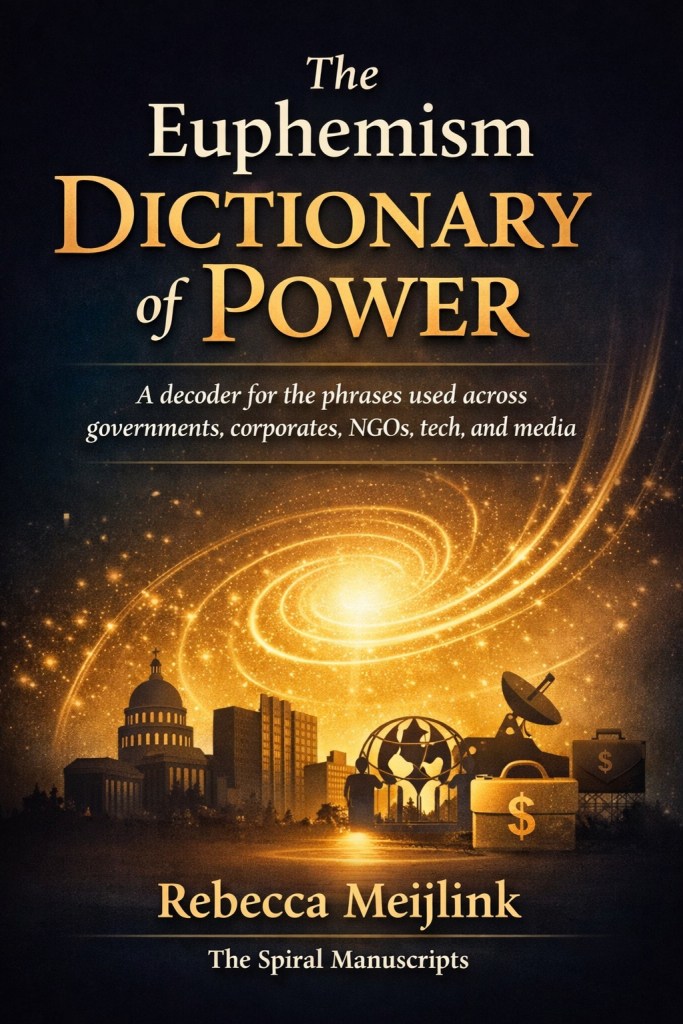
Operating Manual for Institutional Language Manipulation: Demonstrates how narrative hides power. This is not a critique of language. It is a structural decoder for how institutional phraseology transfers liability, obscures extraction, and preserves authority. Each entry identifies who benefits, who carries cost, what is concealed, and how to neutralise the mechanism. Designed for operators working where language functions as infrastructure.

Words That Need Retiring And the Architecture That Must Replace Them
Structural Repair Kit for Language-Driven Collapse: Demonstrates how narrative collapses language. Civilisation does not fail from weak intent but from language that no longer matches reality. This book identifies terms that degrade system function, traces how “positive” words generate misalignment, and provides an architecture for auditing and replacing linguistic operating systems in organisations and institutions.
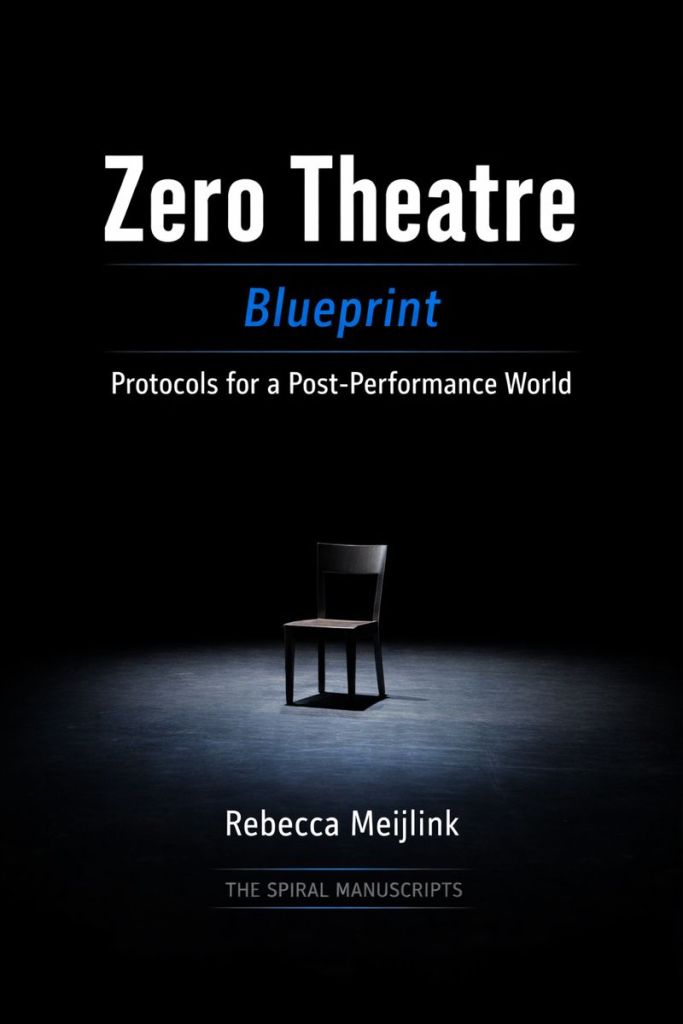
Zero Theatre: Blueprint — Protocols for a Post-Performance World
Execution Architecture for When Visibility Fails: Demonstrates how narrative turns into theatre. When systems stop responding to performance and start responding only to outcomes, visibility becomes a liability. This book provides protocols for exiting theatre logic, terminating performative cycles, and restoring signal-based legitimacy. Designed for leaders and system designers operating where results are the only currency.
Routing: About The Spiral Manuscripts – Institutional Implementation – Individual Implementation – The Five Phase Method – The Operator Interface Architecture – Domain Architectures – Future Business Architecture – Spiral Operator Institute – Narrative Interfaces (Symbolic Transmission) – Library Orientation & Index – Operator Resources – Frequently Asked Questions –Publication Notices – Governance & Legal
Important Notice
Before proceeding, visitors are advised to read the full Legal Notice, Disclaimer & Terms of Engagement. Engagement with The Spiral Manuscripts materials requires psychological stability and informed consent. This site contains advanced conceptual and metaphysical material intended for mature readers. You must be 18 years or older to engage with this content. These works are conceptual transmissions, not professional or therapeutic advice. By continuing to browse this site, you acknowledge that you have read and accepted the terms described at: https://spiralmanuscripts.com/legal-notice-disclaimer-terms-of-engagement/
 The Spiral Manuscripts