
Forthcoming Publication from The Spiral Manuscripts® Library
Why This Book Exists
This page outlines the intellectual rationale and institutional relevance behind The Netherlands: A Repair Model for a Collapsing World. The book forms part of a wider civilisational repair architecture within The Spiral Manuscripts® Library. Grounded in scalar systems analysis and shaped by direct exposure to international institutional conditions, this volume examines how structural resilience is engineered rather than declared. The Dutch case is not treated as a national exemplar but as a functioning repair infrastructure under material constraint—relevant for any system encountering instability, resource stress, or governance breakdown.
Who This Book Is For
• Institutions seeking real-world civilisational repair models
• Operators designing infrastructure under systemic constraint
• Policy strategists navigating planetary risk and governance failure
• Readers of The Spiral Manuscripts® exploring foundational architectural logic
• Analysts moving beyond narrative to structural coherence
Clarifying the Intent
This volume does not concern itself with national pride, cultural identity, or political advocacy. It dissects the Netherlands as a functional system of repair operating under permanent environmental and institutional constraint. The objective is not to export Dutch policy or replicate its institutions, but to extract structural logic relevant to systems under duress—where maintenance, correction, and continuity are preconditions for survival.
Personal Context and Origin of Inquiry
Although I hold Dutch citizenship, my intellectual and professional formation reflects both Dutch and British traditions. I was raised in a bicultural household, with a British mother of Czech descent and a Dutch father born in Indonesia. My analytical work has been shaped by the interaction between Dutch structural formation and British institutional influence.
I received my formative education in the Netherlands. My early adult life and professional career unfolded internationally: three years in Brussels, twelve years in London working for U.S. financial institutions, five years in Monaco, and a decade in the Middle East. This period also included time in Geneva and Gibraltar, as well as traineeships with the European Union, the United Nations, and ABN AMRO Bank.
This trajectory — Dutch formation combined with prolonged exposure to international and institutional environments — prompted a retrospective inquiry: to what extent had the architecture of my analytical work been shaped by the interaction between these formative conditions and long-term engagement with complex institutional systems?
The Vermeer Trigger
The immediate catalyst for this inquiry occurred during a lecture at the residence of the Ambassador of the Kingdom of the Netherlands in London, delivered by the author of Vermeer: A Life Lost and Found. Johannes Vermeer—a seventeenth-century Dutch painter who achieved little recognition in his lifetime and only rose to prominence centuries later—was described not primarily as an artist of emotional expression, but as a practitioner of functional attention. Vermeer, best known for Girl with a Pearl Earring, was recast through this lecture as an architect of precision, not performance. This framing resonated. My own intellectual work bears a stronger resemblance to systems engineering than to expressive authorship—centred on structure, signal integrity, and the discipline of form. The lecture’s emphasis on Vermeer’s formative constraints triggered a parallel reassessment of The Spiral Manuscripts® Library: to what extent was its architectural logic shaped by similar environmental demands, cultural encoding, and disciplined attention?
A Technical Inquiry, Not a Personal Narrative
I began exploring how Dutch educational conditioning, combined with long-term immersion in British, European, and international environments, may have informed my approach to collapse, repair, and systemic design. The inquiry was technical rather than biographical: to what extent could my analytical frameworks be traced to a specific civilisational training environment?
This led to the composition of a scalar study of the Dutch infrastructural system. What emerged was unexpected. Rather than stylistic or cultural signatures, the Netherlands revealed itself as a site of embedded repair logic—rooted in geography, governance, and procedural maintenance. It was not simply a formative environment. It became an empirical case study of civilisational behaviour under sustained existential constraint.
Executive Summary
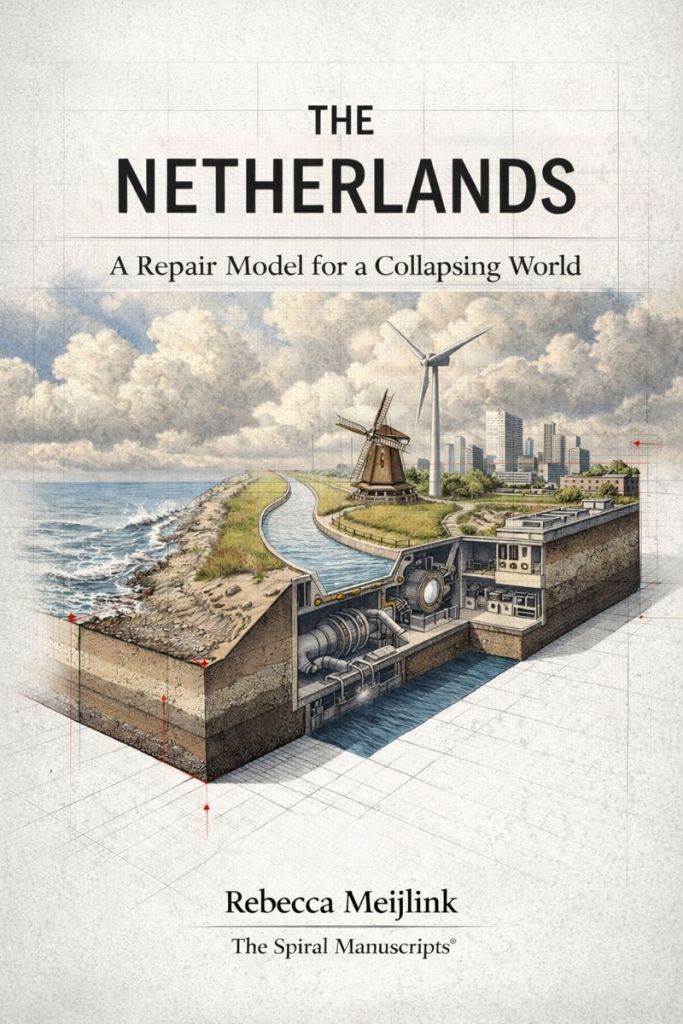
The Netherlands: A Repair Model for a Collapsing World examines the Dutch infrastructural system not as a historical anomaly or policy model, but as an engineered response to sustained existential constraint. Situated below sea level and bounded by physical fragility, the Netherlands had no option but to become a maintenance civilisation. This book dissects how coherence, continuity, and correction became embedded not through ideology or identity, but through environmental necessity and procedural design.
The Dutch model offers a case of real-world civilisational repair. It demonstrates that structural resilience is not a vision but a discipline—rooted in feedback loops, recursive design, institutional restraint, and non-negotiable maintenance. Repair, in this reading, is not reactionary; it is primary. Collapse is not sudden; it is cumulative. And systems endure not because of cultural strength or national pride, but because their architecture makes drift reversible.
This volume maps the Dutch infrastructural logic through the lens of scalar systems analysis. It examines how water management, legal code, decentralised governance, engineering protocols, civic coordination, and institutional design all converge to produce a durable yet non-performative coherence. Each element of the Dutch system is analysed not for replication, but for transferable signal: how repair becomes systemic under pressure.
The analysis is structurally comparative. It contrasts the Dutch embedded repair mindset with institutional drift observed in global systems—supranational bureaucracies that survive by deferring accountability, commercial infrastructures that extend beyond resilience into fragility, and state systems that prioritise growth over maintenance. These global patterns reveal a signal loss that the Dutch case counteracts: a refusal to aestheticise failure or outsource responsibility.
Rather than a call to imitate Dutch governance, this work offers a structural map for systems operating under collapse conditions. It isolates the underlying architecture of repair—feedback prioritisation, loop integrity, failure traceability, and coherent response velocity. The book’s insights are not about Holland. They are about infrastructure. They are about how form encodes function, and how civilisations survive when failure is constant, visible, and unforgiving.
In a collapsing world, the question is no longer whether repair is needed, but whether we understand what repair really is. This book offers a rigorous answer—not as metaphor or policy, but as an operational blueprint.
International Comparison and Learning
The international dimension of my career also became legible within this framework. Engagement with financial institutions in London illuminated how systems persist through legal, procedural, and financial continuity long after their originating rationale has decayed. Time spent in supranational environments such as Brussels and Geneva exposed how coordination can substitute for sovereignty, and how governance can persist despite diffusion of responsibility. Experience in the Middle East revealed how large-scale systems can be rapidly assembled through capital and infrastructure, without necessarily generating internal coherence.
In contrast to the Dutch context—where failure is immediate and physical—these systems are often synthetically extended, sometimes long past their point of internal viability. This juxtaposition oriented my attention not toward ideology or identity, but toward architecture: how systems are constructed, how they degrade, and how they fail.
Collapse as Drift, Repair as Precision
The interaction of these environmental influences shaped an analytical posture that treats civilisation not as narrative or cultural phenomenon, but as operating structure. One strand foregrounded the engineering of systems under physical constraint. Another revealed how systems endure through procedural layering, institutional habit, and reflex continuity. Their conjunction made collapse legible not as sudden rupture but as slow, accumulative drift—and rendered repair intelligible not as symbolic renewal, but as structural intervention.
This book is neither a policy proposal nor a national template. It is a structural dissection of the conditions under which repair logic emerges, embeds, and becomes replicable.
Water Made Error Measurable
The Netherlands did not become a repair-oriented civilisation by vision or ideology. It became one because failure was immediate, observable, and physically consequential. Water made error measurable. Land had to be produced. Maintenance was survival. Over time, this produced a society whose primary competence lies not in growth, dominance, or belief—but in continuous correction.
That competence is now globally relevant. Systemic instability is no longer regional; it is generalised. The Dutch case demonstrates that repair is not a temporary emergency response. It is an operating logic.
Repair as System, Not Sentiment
In this reading, the Netherlands is not simply a geographic territory—it is a structural exemplar. It demonstrates how repair becomes a system of operation under sustained constraint. The structural findings from this analysis inform not only this book, but also the broader architecture of The Spiral Manuscripts®, which codifies repair protocols across sectors, scales, and collapsing civilisations.
For institutional access, advance reading, or to explore the full repair protocol series within the Library, visit:
👉 www.spiralmanuscripts.com
Routing: About The Spiral Manuscripts – Institutional Implementation – Individual Implementation – The Five Phase Method – The Operator Interface Architecture – Domain Architectures – Future Business Architecture – Spiral Operator Institute – Narrative Interfaces (Symbolic Transmission) – Library Orientation & Index – Operator Resources – Frequently Asked Questions –Publication Notices – Governance & Legal
 The Spiral Manuscripts