
Coherent Cities: Architecture, Housing and the Nervous System of Civilisation

Coherent Cities asks a simple, uncomfortable question: what are our streets, homes and public buildings actually doing to the human nervous system.
We’ve treated architecture as backdrop and mental health as a private failure. The result: sleepless housing under flight paths, hostile stairwells and underpasses, schools that feel like low-security prisons, hospitals where corridors do as much damage as diagnoses, and transit systems that burn human bandwidth to keep economic throughput moving.
This book treats the city as an instrument played on millions of bodies every day. Drawing on neuroscience, environmental psychology and scalar systems thinking, Rebecca Meijlink shows how housing, noise, light, air, schools, hospitals, borders, stations and digital overlays quietly re-write stress, sleep, attention and trust.
Coherent Cities is not a coffee-table architecture book and not a plea for “nicer” urbanism. It is a structural argument: if you ignore nervous systems, your city will cannibalise its own future capacity – in health budgets, lost attention, social fragmentation and political volatility. If every field is already tuning behaviour, the only real question is: what are you choosing to tune.
Order your copy on Amazon: https://amzn.eu/d/5Vy3yXS
25 Principles for a Coherent Civilisation: The Codex of The Spiral Manuscripts
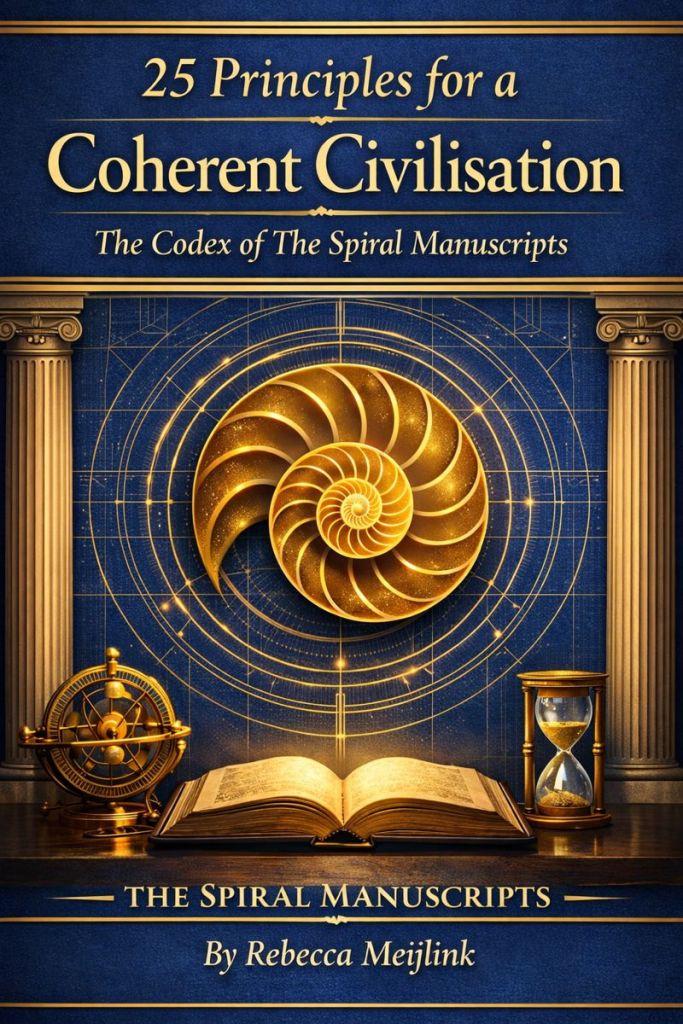
Most books about “better systems” sell values. This one ships instruments. 25 Principles for a Coherent Civilisation is a reference manual for decision-making, record integrity, incentive design, and institutional survival under pressure. It is not a manifesto. It is a diagnostic and build tool: a way to see where coherence leaks, why theatre replaces delivery, and what to do next.
The central claim is simple: modern institutions do not fail from lack of intent. They fail from broken operating conditions: unclear decision rights, un-auditable claims, performative metrics, opaque language, and incentives that reward distortion. Coherence is not consensus. It is operational alignment with reality.
Inside, each principle is presented in a fixed, repeatable format—Definition, What it Replaces, Signal Markers, Failure Mode, Operator Moves, and Fast Tests—so the material can be used to diagnose live systems rather than merely agree with them. The book moves from orientation to principles, to deployment, and finally to a practical future-state view: what governance, law, economy, health, education, and media look like when coherence becomes the design constraint.
This is written for people who are done with performance governance and ready to rebuild capacity: operators inside institutions, founders, advisors, regulators, and readers who want structures that survive hostile reality.
Includes
• The 25 principles in a strict diagnostic template
• Fast Tests to expose theatre, mystique, and metric gaming
• Deployment tools: Coherence Leak Scan and Decision Hygiene
• Implementation paths (30/90 days) and annex reference maps
Order your copy on Amazon: https://amzn.eu/d/esGocdN
Important Notice: By continuing to browse this site, you confirm that you are over 18 and have read and accepted the Legal Notice & Disclaimer at https://spiralmanuscripts.com/legal-notice-disclaimer-terms-of-engagement/
 The Spiral Manuscripts