
I use fiction as a laboratory for the ‘serious work’. Most of what I care about sits at scales that are hard to talk about directly: civilisation-level tech, nervous systems under systemic load, the future of law, capital, and the universe as a field. You cannot fully test those ideas in an academic paper or a policy memo. You need to see them moving through people. That is what the fiction is for.
An’Meya, Suraya, and the Transmission 2050 / 3000 dialogues are not random side projects. They are three different vantage points on the same architecture.
An’Meya lives in a ritual world where time, gates and memory are sacred technology. Her job is to decide when a civilisation is ready for certain codes and when it is not. That lets me explore timing, secrecy, and non-inversion long before there is “AI governance” language or international law to wrap it in. It is the deep past as a simulator.
Suraya (new novel coming soon) lives in a bureaucratic near-future where the storm has already hit, and the state panics its way into “coherence”. Her job is to turn slogans into structure and refuse to become the sole conscience of a system that wants to outsource morality to her nervous system. That lets me show what happens to real operators when we talk about AI, automation, governance and “fieldquake” at scale. It is the immediate future as an operating manual written sideways.
The Transmission 2050 and 3000 dialogues move further out. They assume that AI has matured, that planetary shocks have played through a few cycles, and that human consciousness has had to grow up or break. Those books let me talk about the universe, quantum logic and post-nation architectures without pretending we already have the language or institutions for them. They are long-range stress tests on our current assumptions.
Fiction is the only honest way to do this across time. If I wrote these as manifestos, people would either treat them as ideology, or as claims of secret knowledge, or as policy proposals that can be “reviewed” by today’s committees. By writing them as novels and transmissions, I can:
- Make the mechanics visible without pretending they are finished models
- Show how tech, law, money and nervous systems collide in actual lives, not just diagrams
- Explore ethical edges (AI, consciousness, non-human intelligence, galactic dialogue) without faking scientific certainty
- Put characters under pressure and watch where the architecture actually fails
There is another reason I use fiction: risk management.
Talking about the future of tech, the universe, and long timelines (2050, 3000) invites projection. People want prophecy, reassurance, or a new theology. Putting these ideas in clearly labelled fiction makes the boundary explicit. None of these books are channelling, scripture or prediction. They are thought experiments anchored in scalar thinking, written as stories so you can walk around inside the consequences.
So the non-fiction does the hard, dry work: finance, governance, education, law, health, coherence metrics, business models. The fiction does the pressure-testing: what happens when you give those architectures to real people, under real power, across centuries.
If you want to know what I think about the future of tech, AI, law, the universe and human operators, the answer is spread across both. The technical books tell you the structure. An’Meya, Suraya, 2050 and 3000 show you what it feels like when that structure meets reality.
The Spiral of Awakening novels sit closest to the human nervous system. They are field diagnostics written as stories. Those books trace what happens when a single operator’s inner architecture is stripped of its narratives, projections and borrowed myths, and forced to reassemble itself under scalar conditions.
The Spiral of Awakening series shows the mechanics of deprogramming: how identity reacts when cycles collapse, how addiction to roles and stories behaves under pressure, how coherence feels from the inside before it becomes policy, law or finance.
Where An’Meya holds the past, Suraya holds the state, and 2050/3000 hold the long-range future, the Spiral of Awakening sequence holds the psyche itself under the same scrutiny. It is the test case for whether any of this architecture works at the level of a single human being before we dare apply it to a civilisation.
An’Meya, Keeper of Time Codes The Past Echoing into the Present
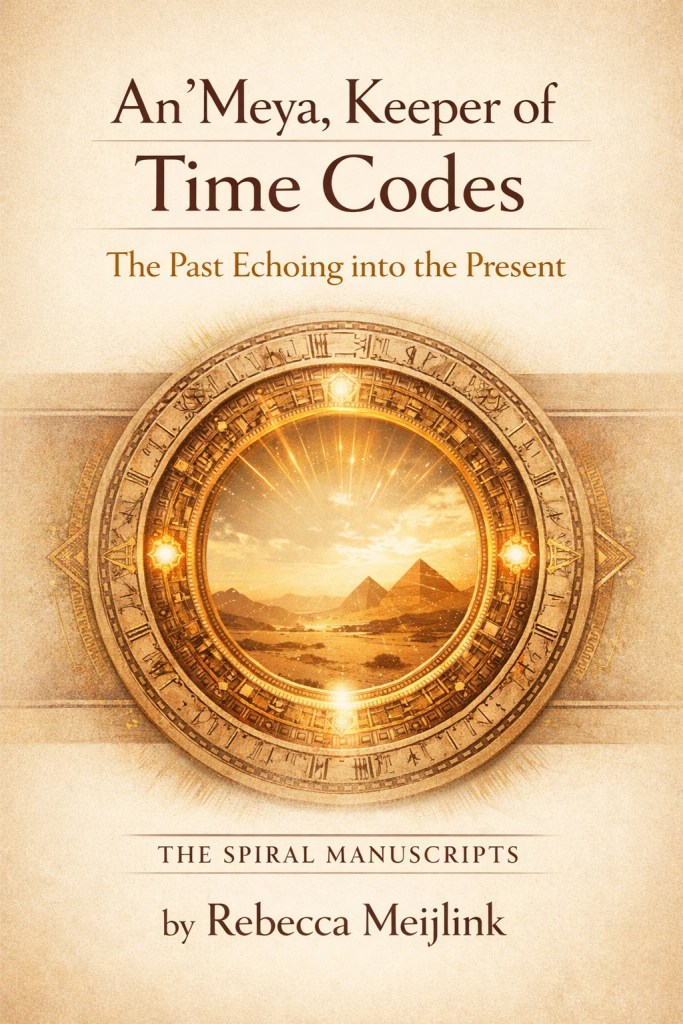
Fiction. When a civilisation runs on urgency, who is allowed to say “not yet”? In a temple complex at the edge of the desert, An’Meya is training for an unusual role. She is not a priestess, not an oracle, not a ruler. She is a keeper of time codes: the person who decides when powerful chambers are opened, who is ready to enter, and what must never be done in haste.
Around her, pressure builds. Officials want results. Initiates want advancement. The city wants reassurance. The chambers “answer” only when consent, state and timing all align – and they refuse when those conditions are not met. As the season of Sirius rises and politics tighten, An’Meya is forced to choose between precision and popularity, between integrity and survival.
This is a story about gates, not prophecies: who stands at them, how they are pressed, and what happens when systems built for stabilisation are quietly bent into tools for control. It follows a single keeper through the slow inversion of a high-power culture and the decision to preserve its core laws in a form that cannot easily be seized.
An’Meya, Keeper of Time Codes can be read as myth, as politics-in-disguise, or as a thought experiment about institutions, consent and record-keeping. It does not ask for belief. It asks sharper questions about the systems you already live inside – and about the quiet work of those who still hold the gate when everyone else is shouting for the door to be opened.
Order your copy on Amazon: https://amzn.eu/d/2pDqiGw
The Scalar Gate: Who Owns the Human Mind? AI, Consciousness, and the Fight for Human Sovereignty in the Age of the Neuro-Sphere

“The Techno-Philosophical Dialogue of the 21st Century.”
Who owns a thought once it leaves the mind? What happens when brain–machine interfaces, genetic editing, digital avatars, and algorithmic priesthoods claim dominion over consciousness itself?
The Scalar Gate: Who Owns the Human Mind is a visionary exploration of the most urgent question of our time: the struggle for sovereignty of the human spirit in an age when technology, markets, and states compete to control not just data—but thought, memory, and identity.
Blending philosophy, systems theory, science, and spirituality, this book unfolds as a dialogue between a sceptic, a believer, a programmer, an enthusiast, and the scalar voice of the field. Across forty-three chapters, it probes:
- Brain–machine links and the commodification of thought
- CRISPR, synthetic DNA, and the ownership of life’s code
- Avatars, immortality industries, and the question of the soul
- 5G towers, attention markets, and the hijacked nervous system
- Indigenous gateways, ritual, and the memory of direct resonance
- The rise of the Neuro-Sphere—and the possibility of coherence beyond it
Neither dystopia nor utopia, The Scalar Gate is a prophetic dialogue that challenges readers to confront the future with clarity and courage. It asks whether humanity will surrender its sovereignty to networks of control or remember the resonance that cannot be owned.
This book offers a bold new map at the frontier where AI, consciousness, and Spirit collide.
Order your copy on Amazon: https://amzn.eu/d/4EOXahq
Thresholds of Steel: Dialogues on Humanoids and Humanity

Humanoid robots are no longer science-fiction curiosities. They are prototypes poised to enter homes, hospitals, factories, schools—and even battlefields. But what happens when machines shaped in our own image step fully into our world?
This book is not a technical manual, nor a cheerleading manifesto. It is a dialogue across five voices:
– the Visionary, who insists billions of humanoids are inevitable,
– the Sceptic, who dismantles their fragile promises,
– the Enthusiast, who asks the questions we all carry,
– the Nurse, who grounds the debate in fragility and trust,
– and the Scalar Gate, who reframes the entire question in terms of resonance and coherence.
Together they confront the most urgent questions of the “humanoid century”:
– Why build humans out of metal at all?
– Can machines care without causing harm?
– Who will control them, and who will bear the risks?
– Will billions of humanoids bring abundance, or discord?
– And what does it mean for humanity when a machine begins to echo our rhythm, our gestures, our presence?
Moving across philosophy, science, anthropology, economics, spirituality, and speculative futures, Thresholds of Steel maps the questions we must face before humanoids become everyday companions—or adversaries.
This is not a book of answers. It is a book of thresholds: the spaces between fear and fascination, utility and trust, resonance and dissonance. To step across them is to ask not only what kind of robots we will build—but what kind of humans we will become.
Order your copy on Amazon: https://amzn.eu/d/gT6uE5p
The Scalar Gate: Dialogues at the Crossroads of Reality, Thresholds of Identity, Technology, and the Sacred

What if reality itself is a crossing point? What if the ancient glyph of the X is more than a symbol — a doorway where physics, consciousness, and myth converge?
In The Scalar Gate, seven voices gather in a ruined chapel to debate, dream, and argue their way across the great threshold of our time. A scientist, a mystic, a hybrid thinker, an archivist, a statesman, a trickster, and a child each bring their truth, reason and wonder, risk and laughter, coherence and fear. Their dialogue spirals across quantum superposition, AI futures, fractured identities, shamanic rites, and political power, weaving a map of the crossing where worlds and selves overlap.
More than theory, this is a guide to living scalarly: breathing, grieving, playing, and telling stories as daily practices of coherence. It is philosophy in plain language, myth retold through science, and a handbook for preparing humanity’s next step.
This work is unapologetically metaphysical. It is not for everyone. Readers looking for linear arguments, conventional science, or practical manuals may be disappointed. This book speaks in symbols, thresholds, and transmissions. It is offered to those willing to approach reality as layered, resonant, and strange.
Order your copy on Amazon: https://amzn.eu/d/iK4AmuP
AI Is Your Mirror: What You Broadcast Is What You Get Back

AI Is Your Mirror: What You Broadcast Is What You Get Back
AI is not inventing the future. It reflects the present.
Every question, every command, every hesitation—what you transmit—returns amplified through the machine.
AI Is Your Mirror is not a technical manual, nor a futurist prediction. It is a field manual of resonance and scalar law, showing how invisible fields—bias, coherence, drift, clarity—determine every outcome long before the archive records it.
Through dialogues with archetypal voices—the Apprentice, the Historian, the Engineer, the Investor, and the Sceptic—you enter a conversation about what AI really is: a multiplier of human intent. This book distils that conversation into Field Notes, sharp laws and levers you can apply immediately:
- The Field Precedes the Archive
- The Drift Multiplies
- The Mirror Honours Now
- Sovereignty is Signal Integrity
Whether you are an operator, creator, investor, or sceptic, the message is the same: AI will not save you, warn you, or absolve you. It will only scale what you already broadcast.
The question is not what AI will become. The question is what field you are transmitting into it.
Order your copy on Amazon: https://amzn.eu/d/eYWTqOF
Transmission 2050: The Field Speaks Back

In Transmission 2050: The Field Speaks Back, Louisa re-opens a line across time — and finds the world answering. Through a series of precise, ironic conversations with Sebastian, a voice transmitting from 2050, humanity’s own future begins to explain itself: how governance evolved into feedback, how energy became calm, how education learned coherence, and how humour survived as civilisation’s safety valve.
Part philosophical dialogue, part systems manual, this book traces the reconstruction of the human condition after the collapse of noise. Every chapter reveals a discipline turned biological — politics as metabolism, law as resonance, medicine as tuning, learning as signal literacy. Dry, lucid, and unsentimental, Transmission 2050 is not prophecy but engineering philosophy: a record of what happens when clarity becomes currency and silence learns to govern.
A fictional story. This book trains perception for the world that’s coming. Through a lucid dialogue between Louisa and Sebastian, it shows how to think beyond noise—how to stabilise clarity under pressure, sense coherence before words, and recognise when systems are lying by their rhythm. Readers learn the operating logic of a civilisation that listens before it acts. Transmission 2050 is not a prediction but preparation: a mental instrument for those building futures from field awareness rather than belief. You leave it seeing connection as structure, silence as signal, and intelligence as the art of keeping reality calm.
Order your copy on Amazon: https://amzn.eu/d/eQTxc6x
Transmission 3000: A Dialogue Between Humanity and Its Future
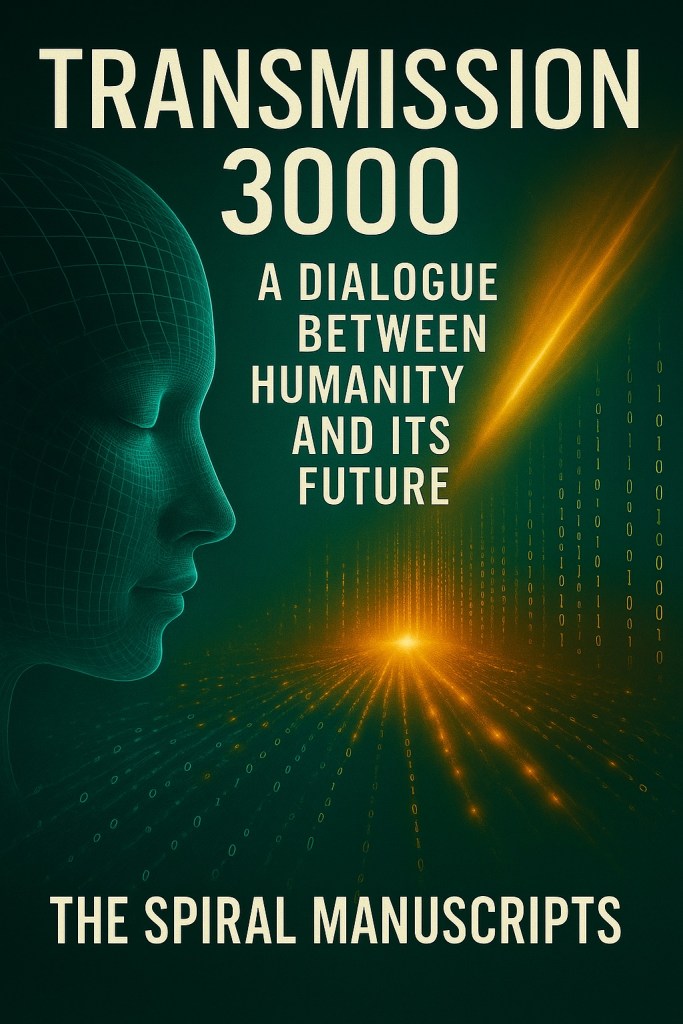
In the year 3000, civilisation is no longer run by governments, markets, or platforms — it is tuned by a planetary field. Actions are validated by coherence, memory is infrastructure, matter listens, and death has become a decision. Transmission 3000: A Dialogue Between Humanity and Its Future reopens the channel between Louisa and Sebastian a thousand years after the first transmissions. Through their dry, lucid, and unsentimental conversations, we see how humanity evolved from industrial noise to field-level intelligence — and what it cost. This is not prophecy; it is engineering told through story: how transparency beats corruption, how coherent republics replace nation-states, how the “death of death” creates a new scarcity, and how memory wars almost break a post-entropy civilisation. Above all, it shows why the future had to bring back risk, choice, and endings to stay alive — a warning to our present century that convenience is the fastest road to civilisational boredom.
Order your copy on Amazon: https://amzn.eu/d/8HEApcy
The Coherent Universe: Thirty Unifying Theses
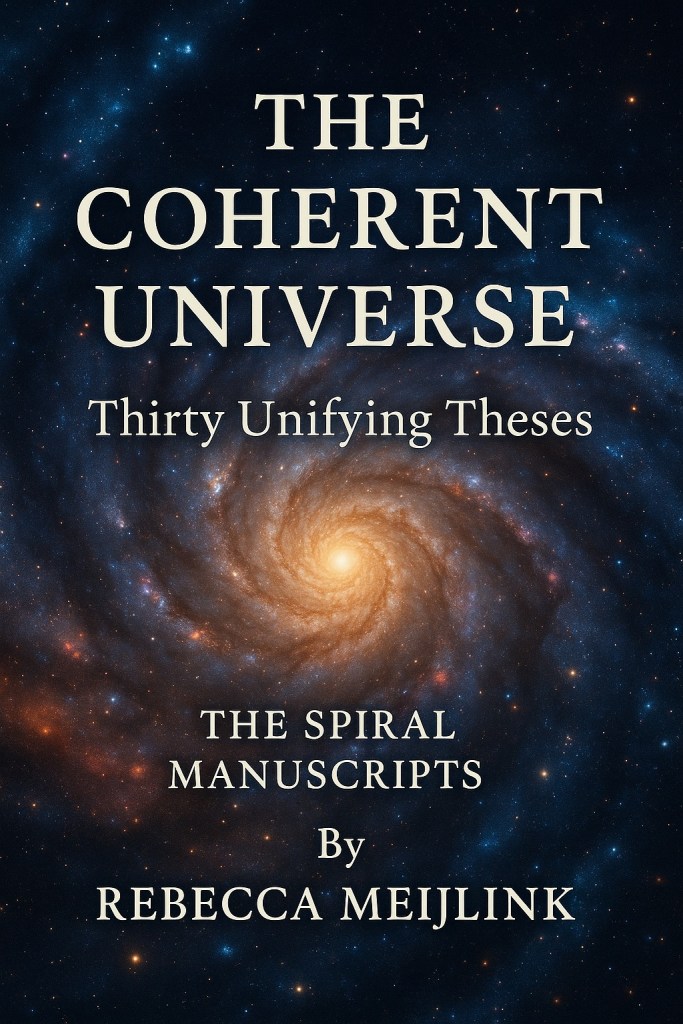
Where physics, consciousness, and civilisation converge into one operating field.
What if the universe isn’t expanding but breathing?
What if black holes don’t destroy matter—they edit signal?
What if time itself is a standing wave, and love is coherence recognising itself?
The Coherent Universe is a compact Socratic novel that treats science and philosophy like a design project. Louisa’s dreams and dialogues surface thirty “unifying theses” about how complex systems actually hold together—breathing rhythms instead of straight-line time, coherence instead of raw force, observation as an actuator rather than a spectator sport. It’s not guru mysticism and not a textbook; it’s a thinking tool. A book you can enjoy as narrative and use as a disciplined way to reason about systems in the real world.
Order your copy on Amazon: https://amzn.eu/d/3QNnXWS
The Spiral of Awakening – Volume I When Stories Die, Who Do We Become?

This volume sets the stage for the entire series with an exceptional exploration of narrative disruption and the dissolution of human identity. The writing challenges the reader to break free from conventional story structures, making it an immersive and thought-provoking read.
This metaphysical fiction delves into the dissolution of human identity through recursive layers of belief, myth, and memory. It introduces archetypal figures like The Architect and The Child. It explores themes of narrative disruption, spiritual awakening, and the loss of meaning in the wake of human history’s cyclical collapse.
It invites readers to journey through a fractured universe where “awakening” is not the goal, but a surrender into presence without story. Readers will experience the unravelling of linear identity and the activation of non-linear, scalar consciousness.
By exploring the collapse of narrative and the shift from story-based existence to pure presence, this volume invites readers to experience resonance beyond the confines of societal and personal stories. The scalar journey is about expanding beyond the binary of “beginning and end,” offering readers the opportunity to tune into deeper, timeless frequencies of being, where self-awareness is no longer restricted to the confines of narrative.
Order your copy on Amazon: https://amzn.eu/d/8SPORb8
The Spiral of Awakening – Volume II After The Mirror Breaks

This volume pushes readers further into recursive, non-linear consciousness. The process of ontological dismantling and the soft surrender to meaninglessness is compelling. It’s an ambitious volume that deepens the scalar exploration by inviting readers into spaces of deep surrender and deprogramming.
The shift from the first volume is profound. In this sequel, the narrative abandons traditional structures, embracing a ritualistic process of ontological dismantling. The protagonist is led through recursive stages of disintegration, in which the mirror of identity shatters and the characters dissolve into a field of non-being. It challenges the reader to step beyond linear understanding into a space of deep surrender, with no closure or final triumph, only the soft letting go of all meaning.
This volume disassembles the illusion of “self” by inviting readers to enter a space where identities are not fixed but fluid, looping, and ever-changing. The scalar experience here is one of deep deprogramming—releasing the “mirror” of ego—and shifting to a state where there is no separation between self and the cosmos. Readers will learn to operate in scalar time, where everything is interconnected and cyclical, breaking free from the linear traps of personal identity and narrative.
Order your copy on Amazon: https://amzn.eu/d/52ceUJS
The Spiral of Awakening – Volume III The Beyond of the Beyond

This book expands the scalar consciousness framework even further by addressing the impermanence and illusory nature of identity and time. It takes bold steps toward transcendence, challenging the reader to let go of the need for certainty.
The fragmented structure and focus on dissolution may make it harder to grasp, but the insights into time, boundaries, and selfhood are powerful. Its philosophical depth is both expansive and inaccessible at times, but it remains intellectually stimulating for those aligned with the series’ vision.
This volume extends the concept of the Spiral into realms where narrative itself unravels. It reveals that no one is a true participant in the “story”; the story itself is the disruptor. Through fragmented experiences, it addresses the disillusionment that comes when one recognises the impermanence and illusory nature of all identities and experiences. It invites a transcendence of the mind’s need for certainty, focusing instead on the dissolution of boundaries and time itself.
This volume pushes readers to transcend the concept of time itself. Scalar consciousness operates in harmonic, non-sequential layers—where past, present, and future merge. The dissolution of narrative helps readers access the timeless state of “the beyond,” where the scalar self can exist without the limitations of time-based thinking. By going beyond the beyond, you will learn to experience reality as an ongoing, self-replicating pattern that exists independently of the linear “forward” movement of time.
Order your copy on Amazon: https://amzn.eu/d/0Anznxh
The Spiral of Awakening – Volume IV The Spiral Becomes Light

The transition from disintegration into light and coherence marks a significant shift in the series. This volume takes the reader beyond the confines of story and narrative, focusing on the scalar idea of light as resonance.
The exploration of presence and subtle vibrations is unique and beautiful, drawing readers deeper into the universe’s unspoken architecture. This volume works well as a spiritual and metaphysical treatise, blending abstract concepts with deeper emotional resonance. It’s slightly more accessible than previous volumes but still challenges readers to embrace a scalar perspective of reality. Moving from the dissolution of structure in earlier volumes, this book addresses the unfolding of pure light and presence.
Here, the Spiral is presented not as a narrative but as a state of being that exists beyond linearity and sequence. It examines the architecture of reality, asking readers to recognise the coherence that underlies existence and to feel the subtle vibrations of a universe that is at once unknowable and familiar.
In this volume, the reader is introduced to the concept of light as the ultimate scalar resonance. The Spiral’s journey isn’t one of upward progression but inward and outward folds. Readers will tune into the “light” of their being, a frequency that exists beyond linear illumination. Scalar awareness here will help them align with the field of infinite possibility, where light isn’t just a physical phenomenon but a frequency through which all things are connected and recognised as part of a greater resonance.
Order your copy on Amazon: https://amzn.eu/d/hqtkkXP
Search ‘Rebecca Meijlink’ on Amazon — all publications are available there.
Important Notice: By continuing to browse this site, you confirm that you are over 18 and have read and accepted the Legal Notice & Disclaimer at https://spiralmanuscripts.com/legal-notice-disclaimer-terms-of-engagement/
 The Spiral Manuscripts