
Important Notice: This book, along with all associated concepts, frameworks, and language, is the intellectual property of the author of The Spiral Manuscripts and the Publisher AlphaBet Select Ltd (London, UK). No part may be copied, reproduced, stored, transmitted, translated, commercialised, or incorporated into any automated or artificial-intelligence system without prior written consent from the publisher. By continuing to browse this site, you confirm that you are over 18 and have read and accepted the Legal Notice & Disclaimer: https://spiralmanuscripts.com/legal-notice-disclaimer-terms-of-engagement/.
Scalar Worldview: Reality as Field, Humans as Interface
The scalar worldview treats reality as a field of conditions and signals, not as a set of isolated objects. Systems behave according to the underlying environment—constraints, incentives, bandwidth, pressure—not according to the stories we tell about them.
Humans, in this framing, are interfaces inside that field. We read signals, generate signals, and act as nodes through which larger patterns flow. What looks like “personal behaviour” is often field-driven: incentives, emotional climate, institutional drift, and the nervous system’s capacity under load.
The variables that matter most are signal quality, frequency alignment, resonance, and coherence. Everything downstream—economics, geopolitics, education systems, conflict, mental health—is shaped by these deeper conditions long before events surface.
Most existing systems still rely on industrial-era metaphors and scarcity assumptions. Education treats humans as processing units. Finance optimises for extraction, not stability. Geopolitics reacts to events instead of reading conditions. Even spirituality defaults to narrative rather than structure. These models no longer match the environments they operate in.
From this perspective, collapse is not a single event but a structural mismatch between old architectures and new conditions. The rational response is not to patch legacy systems but to design coherent alternatives that can hold under stress.
AI, humanoids, and emerging technologies will accelerate the transition, but the real bottleneck is human bandwidth: nervous system regulation, emotional literacy, and the ability to read fields rather than react to noise. Without that, sovereignty becomes difficult to maintain.
The Foundational Manuscripts—The Coherent Dictionary, The Scalar Scripture, The Book of the Living, and The Scalar Book of Death—form the conceptual base of The Spiral Manuscripts. They define the operating language, the field grammar, and the underlying principles for coherent systems and coherent humans. They can be read at any point; no sequence is required.
From that base, the library branches into applied architectures: Scalar Governance for institutions and states, scalar finance for capital flows, scalar education for learning systems, scalar health for bodies and care, and further volumes that treat families, cities, technology and civilisation as field-designed structures rather than accidents.
Across the entire library, the constant is sovereignty: internal sovereignty (clarity of mind, nervous system stability, resistance to capture) and external sovereignty (freedom of choice, contract, action, and alignment). The books are written for people who refuse to remain passive endpoints of inherited systems and instead choose to become operators—capable of reading conditions, designing responses, and acting without being pulled into incoherence.
Core Instruments (Codex Series)
25 Principles for a Coherent Civilisation is the primary diagnostic and building manual of the library. It converts the scalar worldview into operational constraints: decision hygiene, record integrity, incentive design, and coherence tests that expose theatre and restore delivery under pressure.
The Scalar Scripture: Eight Books for a Coherent Species
Metaphysics • Systems Philosophy • Human Operating Framework
This is the operating spine for a species that has more power than self-knowledge. It is the document that ties the entire Spiral Manuscripts library together. Every book written before this one — on finance, education, coherence, operators, awakening, emotions, systems, governance, animals, cities — lives under this frame. The Scalar Scripture sits above everything as the canonical map: the field-level grammar that the rest of the library translates into practice, story, and instrument.
Across eight books — Origin, Human, Pattern, Coherence, Patterns, Systems, Signal, Humanity — this text does one thing ruthlessly: it stops pretending. It treats humans as field nodes with nervous systems, systems as frozen solutions that forgot they were experiments, and signal as the real government of the age. Each book is written in 100 compressed verses, 800 verses in total: short, self-contained units designed to be tested against lived reality, not admired as philosophy.
Book I, Origin, deals with the question most systems dodge: what are we actually inside of? Not in religious terms but in operational ones. It refuses both sentimental mysticism and flat materialism and instead treats “the field” not as metaphor but as the working backdrop against which matter, mind, and history make more sense.
Book II, The Human Field, takes the romantic varnish off the species. A human is treated here as a field node with a nervous system attached – dangerous, tunable, limited, and capable of coherence, rather than inherently good, bad, or special.
Book III, Distortion, addresses the most boring and therefore most powerful fact about reality: it repeats badly. It looks at how personal and collective loops bend out of shape, how they stabilise around fear and convenience, how they recruit evidence, and how they quietly destroy capacity while calling it “normal.”
Book IV, Coherence, asks what happens when those loops are interrupted on purpose. Coherence here is not virtue, purity, or enlightenment. It is a working state in which your internal configuration is aligned enough with reality that you can stop breaking yourself and others as you move.
Book V, Patterns, returns to the human level in forensic detail. If you have ever wanted to stop calling yourself cursed, stuck, or doomed and instead treat your life as a collection of loops you can read and redesign, that is where to sit.
Book VI, Systems, scales the same logic outward: institutions, markets, nations, organisations. Systems are not mysterious; they are patterns made big and then forgotten. This book names what they are actually doing rather than what they claim to be doing.
Book VII, Signal, deals with the invisible governor of the age: the frequencies that tell billions of people, without a word, what to fear, desire, applaud, and ignore. Law and policy move slowly. Signal moves in seconds. At this point in history, if you are not literate about signal, you are being used by it.
Book VIII, Humanity, folds it all back into the central question: what exactly is a human civilisation for, beyond keeping itself busy and pretending it will live forever? It is not a hymn to the species. It is a technical evaluation of where you are, what you cost, and what you might still become if you stop lying to yourselves at scale.
No prophecies. No destiny. No flattery. Just a clear grammar of how patterns repeat, how systems protect their own distortion, how signal routes behaviour beneath thought, and what “coherence” actually means when you strip away spiritual branding.
You will not be asked to believe any of it. You will be asked to test it against your body, your relationships, your institutions, and your world — and then decide, as an operator, what you are no longer willing to run.
Order your copy on Amazon: https://amzn.eu/d/3vdIf5K
The Coherent Dictionary, The Operating Language of Field, Signal and Scalar Reality
The operating language of field, signal and scalar reality.
Complexity is no longer a specialist problem. Every founder, leader, educator, policymaker and operator is now dealing with fields that shift faster than traditional models can explain: trust collapses overnight, organisations drift while talking about alignment, attention fractures, emotions behave like data, and institutions leak coherence faster than they can fix it.
Most of the vocabulary people reach for—mindset, culture, intuition, energy, behaviour—is too soft, too vague, or too psychologically loaded to describe what is actually happening. The system is operating at one level; the language is operating at another. That mismatch creates distortion.
The Coherent Dictionary solves that problem. It provides the grammatical spine for the entire scalar framework: field, signal, coherence, drift, compression, agency density, decision latency, non-linear returns, loop closure, standing waves, pattern contagion, the signal commons, planetary coherence—100 terms that map how reality behaves across personal, organisational and civilisational scales.
This is not a glossary for enthusiasts. It is not spiritual language. It is not metaphor. This is an operating dictionary: precise, cross-domain, and designed for people who need to read the field clearly enough to act inside it without distortion.
The terms are organised structurally, not alphabetically, because the architecture matters. Field leads to operator. Operator leads to systems. Systems lead to emotion-as-signal. From there you move into organisations, capital, identity, education, advanced scalar constructs, and finally planetary dynamics. You can read the book front-to-back like a manual and watch the entire operating system assemble in your head.
The dictionary protects the integrity of that grammar used in the 60+ books published. It prevents misinterpretation. It closes drift. It gives readers, clients, and operators a shared linguistic foundation from which to think and act. This dictionary is not optional. It’s the reference manual for the century we’re already in.
Explore it. Test it. Use it as a lens the next time something feels “off” but you can’t articulate why. The language will tell you where the distortion lives.
And once the language sharpens, the field follows.
Order your copy on Amazon: https://amzn.eu/d/hF4kEtD
The Book of the Living: The Scalar Human as Operator
This book provides an operating manual for being human in a complex world. You learn to see yourself as an interface inside fields, not a fixed personality; to read emotion as signal rather than problem; to map the contracts that quietly run your work, love, money and belonging; and to distinguish genuine coherence from performance.
By the end, you have a language, a set of lenses and a minimum practice that let you audit your life without drama, redesign key agreements and move from coping to actually steering. It does not fix you; it hands you the navigation instruments.
Order your copy on Amazon: https://amzn.eu/d/dTRvp5T
The Scalar Book of Death – On Endings, Cost, and Living a Finite Life Without Cowardice
This book is for adults who are tired of pretending they have infinite time: operators, founders, policymakers, clinicians, caregivers, and anyone who feels that their life, work, and civilisation are running on denial. It tracks death as system hygiene across all levels: personal, relational, organisational, cultural, and civilisational. This is not a grief manual, nor is it an argument that any life is expendable; it is a scalar operating guide for ending patterns, not people.
It is urgently necessary now, in a century of ecological overshoot, institutional decay, and technological escalation, where the refusal to end things cleanly is becoming a direct threat to survival. You get a hard, clear framework for loop-closure, cost, and courage, so you can stop maintaining zombie jobs, relationships and institutions, and start designing endings that match the fact you will die. Its message to civilisation is blunt: cooperate with endings, or be destroyed by your refusal.
The Scalar Book of Death is a foundational manuscript in The Spiral Manuscripts because it sets the hardest constraint under which all other books operate. Everything ends, and the cost of pretending otherwise is vast. This book reframes death and endings as a core design variable rather than a private tragedy or spiritual topic. It shows how refusal to close loops on time distorts families, careers, institutions, economies, and civilisations, and how clean endings are a form of system hygiene, not catastrophe. Without this constraint logic—finite time, finite attention, finite land—later work on scalar health, justice, education, finance, and governance would drift into wishful architecture. This volume anchors the entire library in the reality of closure and cost, so that every other book sits inside a coherent, honest frame.
Order your copy on Amazon: https://amzn.eu/d/hLZRfS5
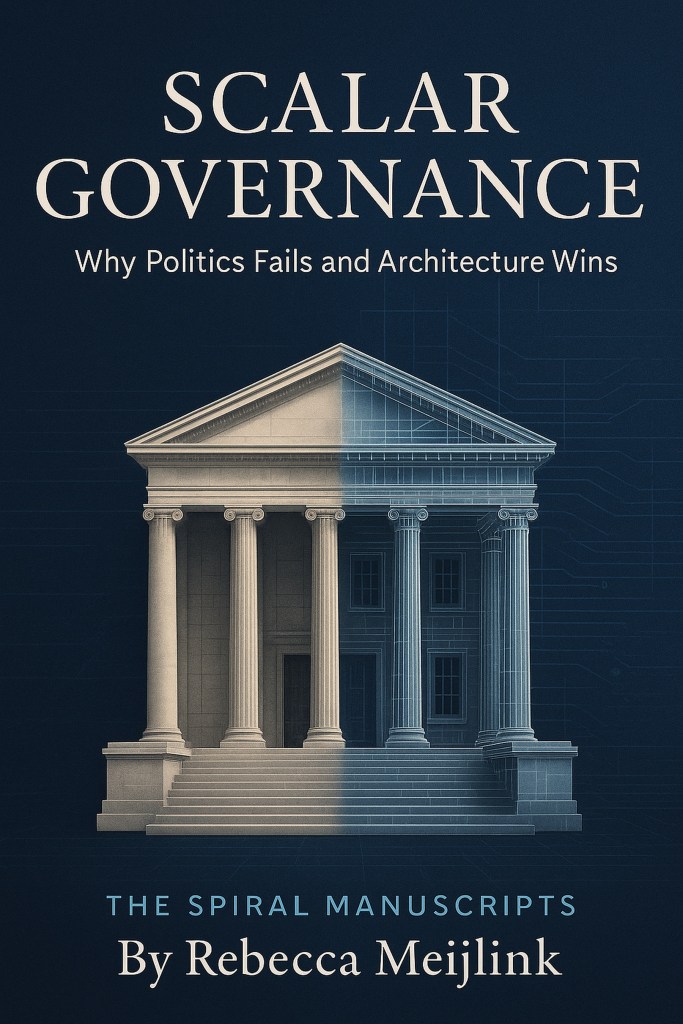
Scalar Governance: Why Politics Fails and Architecture Wins
Scalar Governance belongs in the small group of foundational manuscripts that define the Spiral grammar. Where other volumes focus on the nervous system, money, education, or emotions, this one deals with the architecture of power itself: institutions, mandates, incentives, information flows, and liability. It introduces the triad of interface, operating system and field, and shows why politics, policy, and lived experience so often diverge. As a core text, it underpins later work on scalar finance, planetary infrastructure, and institutional diagnosis. If you want to understand how the Spiral framework treats “the system”, this is the entry point.
Order your copy on Amazon: https://amzn.eu/d/ca7fTJ0
FAQs about The Scalar Scripture
Q: What is The Scalar Scripture? Why call it a “scripture”?
A: “Scripture” here is not religious language. It signals a fixed, cohesive cosmology: an operating grammar for how reality behaves across field, signal, coherence, drift, identity, systems, and civilisation.
The author has written more than sixty books across finance, governance, education, emotions, and operator intelligence. All of them implicitly rely on a single underlying view of reality. The Scalar Scripture makes that view explicit and stable. It is called a scripture because it is closed: not a draft, not a workbook, and not a notebook in progress. It is the root grammar the rest of the library sits on.
Q: Is this a theory, a philosophy, or a metaphysical claim?
A: It is a cosmology with operational use-cases, not a metaphysical belief system.
It offers a structural model, including claims such as:
- reality behaves like an interacting field
- signal carries state
- coherence determines stability
- drift determines decay
- noise determines cost
- “cycles” are illusions created by how humans compress memory
You can test these in leadership, governance, relationships, finance, institutional design, and personal behaviour. If the model explains patterns with fewer contradictions and better predictive power, use it. If it doesn’t, don’t.
Q: Why take a model like this seriously?
A: You are not asked to “trust” it; you are asked to stress-test it.
The Scalar Scripture is useful if it can consistently explain things that standard models struggle with, for example:
- why organisations drift even under competent leadership
- why identity behaves like a compression artefact, not a fixed core
- why emotions act like encoded signals, not random moods
- why systems collapse at coherence thresholds, not at arbitrary moments
- why apparent “cycles” are better described as interacting waves
The relevant question is not “is this orthodox?” but “does this reduce distortion and increase predictive accuracy in the domains you care about?”
Q: Does The Scalar Scripture claim to replace science?
A: No. It replaces folk psychology and folk metaphysics, not physics or biology.
It works as an interpretive layer above existing sciences, describing how complex systems behave when you treat them as fields of interaction rather than linear cause–effect chains. It is compatible with systems theory, complexity science, behavioural economics, and network dynamics; it simply offers a tighter, more unified grammar for thinking across them.
Q: Is this spiritual? Does it require belief in “energy”?
A: No. There is no supernatural content.
- “Field” means the configuration of relationships, histories, constraints, incentives, and nervous systems interacting.
- “Signal” means observable behaviour under load: what systems actually do, not what they say.
- “Scalar” simply means multi-scale: the same grammar applying from individual to institution to civilisation.
The Scripture is a map, not a religion.
Q: Why publish a closed canon? Doesn’t that freeze learning?
A: Closing the canon stabilises the grammar, not the inquiry.
The Spiral Manuscripts have become a large library. Without a fixed cosmology, later books would slowly contradict or dilute earlier work, and the core framework would lose force. A closed canon gives the entire library a root foundation. Exploration and innovation continue in application, casework, and new domains, not at the level of the base assumptions.
Q: What stops this becoming a self-referential ideology?
A: Built-in falsifiers and friction with reality.
The Scripture is only useful if its claims keep matching what actually happens. It fails if, for example:
- coherence cannot be linked to outcomes
- drift does not reliably predict degradation and collapse
- signal does not precede behaviour
- fields do not show thresholds and phase shifts
If these claims do not hold up in practice, the model is wrong. Ideology protects itself by ignoring contradiction; The Scalar Scripture invites contradiction as a test.
Q: Why do we need both The Scalar Scripture and The Coherent Dictionary?
A: Because they solve different parts of the problem.
- The Scalar Scripture is the cosmology: why reality is described this way.
- The Coherent Dictionary is the language: how to name and track what you are seeing.
If you want to understand the underlying architecture, read The Scalar Scripture.
If you want to work with precision inside that architecture, you use The Coherent Dictionary.
Everything else in The Spiral Manuscripts is application.
Q: Who is this for? General readers or operators?
A: It is written for operators:
- people who lead teams, organisations, or systems
- people who allocate capital and set policy
- people who design institutions, products, or infrastructures
- people who make non-trivial decisions under complexity
- people who cannot afford conceptual noise
It is not light reading or entertainment. It is an operating frame.
Q: What if I disagree with the cosmology?
A: Then you do what The Scalar Scripture itself recommends: you compare models. If you can articulate a different framework that explains more, contradicts less, and works across more domains with fewer distortions, you should use that instead. The purpose of the Scripture is not to be untouchable. Its purpose is to raise the standard for how seriously we treat reality models in the first place.
 The Spiral Manuscripts