
Important Notice
This work, including its concepts, frameworks, and original language, is protected by copyright and other intellectual property rights and is published by AlphaBet Select Ltd (London, UK). No part may be copied, reproduced, stored, transmitted, translated, commercialised, or reused in any system or product without prior written consent from the publisher, except where permitted by law (for example, brief quotations for review with attribution). By continuing to browse this site, you confirm you are 18 or older and that you have read and accepted the Legal Notice & Disclaimer.
Introduction to the Refusal Architecture Series
This series exists because modern life increasingly runs on forced openness. Institutions demand “collaboration” without terms. Organisations demand “alignment” without exits. Relationships demand “vulnerability” without protection. Platforms demand “transparency” without reciprocity. In each case the pressure is the same: keep things informal, assume good faith, lower your defences, and treat boundaries as a personality flaw. When capture happens it is reframed as a communication problem. When coercion works it is renamed as teamwork. When you resist you are told you have trust issues.
The Spiral Manuscripts proceed in three deliberate phases. (1) First comes Refusal Architecture. (2) Then comes The Reset: Restoring the Signal. (3) Then comes Coherence Architecture. This ordering is not a mood. It is structural. Coherence cannot be built on a compromised surface. If your access rules are vague, your records are weak, and your stop-lines are missing, “coherence” becomes a prettier word for compliance. Collaboration turns into extraction. Inclusion turns into inversion. Consensus turns into soft coercion. Refusal clears the field. The Reset restores signal clarity after withdrawal from distortion. Coherence organises what remains into systems that can self-correct under stress.
Refusal Architecture is the discipline of designing your life and work so cooperation cannot be converted into extraction. It is not cynicism. It is not paranoia. It is not antisocial behaviour dressed up as a philosophy. It is engineering: gates instead of vibes, records instead of rewritten memory, and exits instead of endless negotiation. It treats integrity as a system property: something you build into environments through conditions, timing, proof, and stop-lines. It assumes incentives are real, pressure is predictable, and narratives will be contested.
The Keeper Laws establishes the primitives: timing, gates, record, and non-inversion. It explains why doors fail, why openness gets exploited, and why refusal is a structural competence rather than an emotional reaction. Gates Not Doors turns the primitives into deployable access architecture: conditions, variables, refusal logic, monitoring signals, seals, and patterns that keep systems clean under stress. Record Integrity is the memory layer of the system. It exists because gates fail without proof. In the modern environment, capture is rarely completed through force; it is completed through narrative manipulation: excerpt warfare, context deletion, selective screenshots, reinterpretation, and rewrite regimes. When record discipline is weak, you cannot prove what was agreed, what was done, or who altered the frame. Record Integrity shows how to build archives that resist context insertion and how to treat version control as a civilisational survival function rather than an administrative nicety.
Abort Criteria (to be published soon) is the exit layer. It exists because even well-built gates are worn down by pressure, reputational leverage, urgency theatre, and the subtle moral blackmail of “being reasonable”. Without explicit stop-lines, refusal becomes improvisation under stress — and improvisation is exactly what hostile environments exploit. Abort Criteria installs non-negotiable triggers for pause, refusal, sealing, and departure across partnerships, policy work, press exposure, standards bodies, institutional participation, and intimate agreements. It treats stopping as competence, not failure, and makes refusal executable.
Trust In an Age of Rational Distrust is the gateway volume. It begins where most readers actually live: in a world where default trust has collapsed, and suspicion is often rational data, not pathology. It shifts the question from “do I trust them?” to what you can trust them with, at what scale, under which incentives, under what conditions, and with what exits.
The Euphemism Dictionary of Power exposes the language layer of capture. Most coercion does not arrive with obvious threats; it arrives dressed as kindness, safety, inclusion, and responsibility. Euphemisms are governance tools. They blur accountability, soften harm, and extract compliance while sounding reasonable. This dictionary makes semantic manipulation legible so you can detect drift early, before you are pressured into agreement by words engineered for your consent. How Stories Blind You to Reality maps narrative as attack surface. Modern conflict is rarely about facts alone; it is about framing, omission, excerpt warfare, moral scripting, and replay. People are not usually trapped by lies. They are trapped by stories that make certain choices feel mandatory and other choices feel unthinkable. This book shows how narrative overrides perception and how to regain clarity when social reality is being actively authored around you.
Coherence Under Constraint is the stress test. Many people can hold boundaries when life is calm. Refusal Architecture is designed for conditions that are not calm: deadlines, reputational pressure, urgency theatre, institutional intimidation, financial scarcity, and social smear risk. Under constraint most people abandon structure for relief, and that is when capture completes. This book shows how to keep gates, records, and refusal lines intact when the system is pushing you to “be reasonable”.
Read together, these volumes form a defensive system. The Keeper Laws provides the primitives. Gates Not Doors installs access control. Record Integrity provides proof and continuity. Abort Criteria provides exits and refusal under pressure. Trust In an Age of Rational Distrust provides the human on-ramp and the vocabulary to stop self-doubting your own pattern recognition. The Euphemism Dictionary of Power protects the language layer. How Stories Blind You to Reality protects the narrative layer. Coherence Under Constraint stress-tests the whole stack.
The second phase of the wider library, The Reset: Restoring the Signal, sits immediately after this defensive stack. It exists because once you stop participating in distortion, you often have to recalibrate perception: restore discrimination between signal and story, recover bandwidth, and interrupt the reflex to re-enter false coherence for comfort. Only after refusal and reset does the third phase — coherence architecture — become clean and buildable.
Everything else in the library builds outward from here. Once refusal is installed and signal is restored, coherence becomes possible: clean cooperation, stable institutions, resilient infrastructures, and civilisational design that cannot be inverted by language games, narrative capture, or reputational blackmail. The rest of The Spiral Manuscripts is the architecture of what can be built when the system is no longer allowed to take you.
The Refusal Architecture branches into sectoral blueprints and human operating manuals across the library.
If you want the institutional expression of refusal, begin with Justice as a Nervous System, which treats law, conflict, and enforcement as a design problem of loop closure rather than moral performance. It shows what happens when systems cannot stop, cannot repair, and cannot prove what they did. If you want the civilisational layer—how refusal becomes a stable design principle for nations and infrastructures—move into The Coherent State, The Healthy Nation-State, and War and Peace in the 21st Century, where coercion, legitimacy, and conflict are treated as structural outputs of system design, not merely political drama. If you want the economic layer—how extraction and narrative capture travel through money, risk, and capital—read The Coherence Economy, The True Work of Money, and From ESG Narrative to SFRC Execution: The SFRC Overlay, which translate refusal into incentives, measurement, and deployment.
If you want the personal internal layer of capture—where refusal collapses before any external gate is even installed—read Emotional Obedience, Bandwidth in the Body, and The Operator Phases. These sit underneath refusal architecture like wiring under a control panel: they explain why people comply against their own interests, why exhaustion creates involuntary openness, and how to rebuild the operator who can hold boundaries without becoming brittle. If you want the language system extended beyond euphemisms, The Coherent Dictionary sits as the broader reference layer: the operating language that keeps the work precise and resistant to semantic drift.
And if you want the larger planetary architecture projects that share the same anti-capture stance—governance, energy, media, and education as systems that must resist manipulation—then Resonant Earth — Volume I: The Scalar Blueprint for a Coherent Planet, RESONANT EARTH VOLUME II THE PLANETARY COHERENCE CONSTITUTION, The Signal Grid, The Coherence Grid, and Scalar Education: Rebuilding Learning from Nervous System to Nation take refusal principles and scale them into civilisation design. They are not part of the Refusal Architecture series itself, but they are built on the same premise: a coherent civilisation is not produced by moral slogans; it is produced by structures that prevent inversion.
Read the series as a defensive stack, then use the rest of the library as specialised deployments. The spine teaches you how not to be taken. The wider catalogue shows what becomes possible when refusal is no longer a personality trait but a civilisational design principle.
THE KEEPER LAWS: Timing, Gates, Record, Non-Inversion – Governing High-Power Systems (Book 1 in a Series of 4)
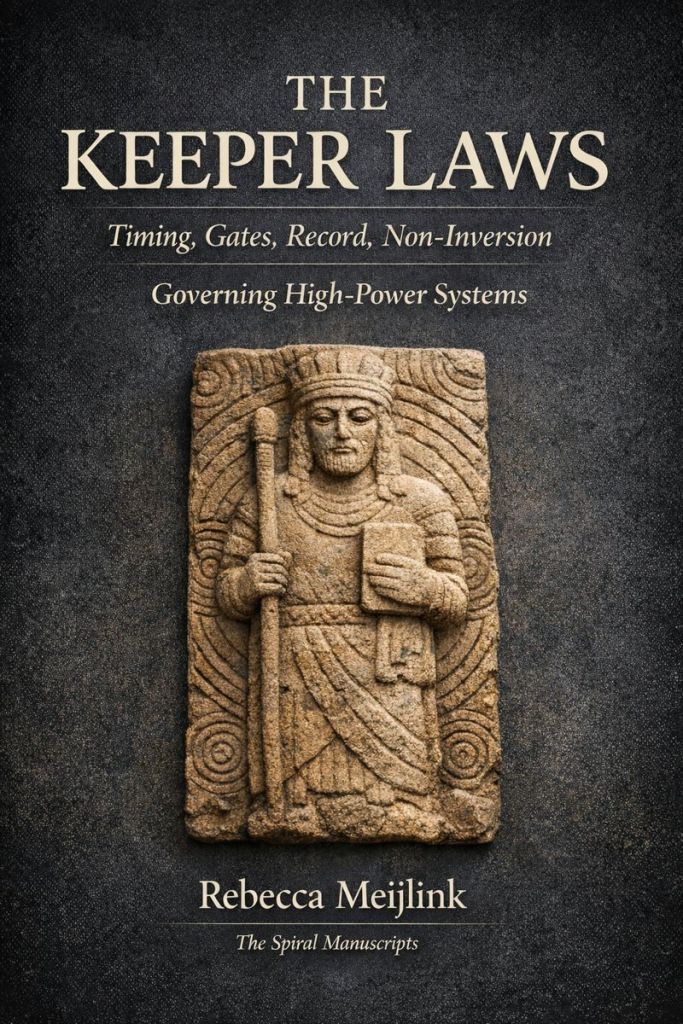
Non-Fiction. A companion work, An’Meya, Keeper of Time Codes: The Past Echoing into the Present, serves as this book’s narrative laboratory. You will find this book under the tab ‘Powered by Pyramids’.
Power doesn’t collapse civilisation by shouting. It collapses it by drifting: one exception, one rebrand, one “temporary” policy, one silent edit, one manufactured urgency until the system’s stated purpose becomes cover for its opposite outcome. The Keeper Laws is a practical framework for building systems that don’t self-invert under pressure. It defines four primitives: timing windows, gates, record integrity, and non-inversion testing. It then turns them into installable constraints: checklists, abort lines, misuse-mode diagnostics, and refusal scripts. This is an engineering approach to governability.
If you build, fund, regulate, audit, or depend on high-leverage systems, this book gives you the vocabulary to see drift early and the mechanisms to stop it.
Order your copy on Amazon: https://amzn.eu/d/f08Ws7R
Gates Not Doors: Conditions Against Corruption (Book 2 in a Series of 4)
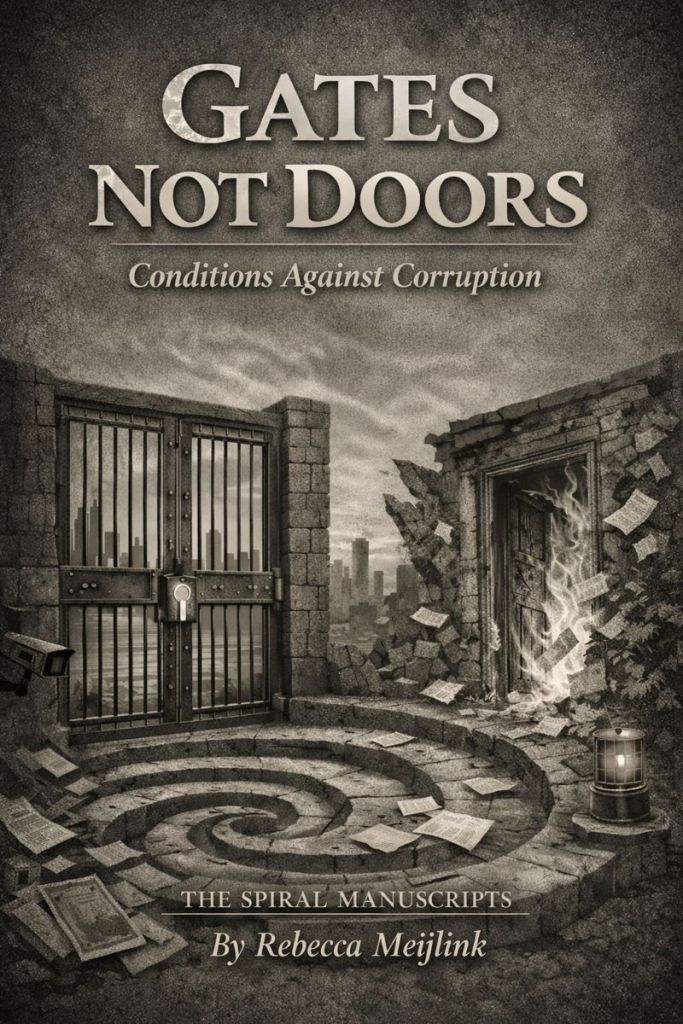
This is a systems book about the most under-designed problem in modern life: who gets access to leverage.
Most organisations still run on doors—discretionary permission, social pressure, backchannels, and expanding exceptions. Doors do not scale. Under load, they become a capture interface.
This book replaces doors with gates: explicit purpose, explicit variables, explicit opening conditions, explicit refusal logic, minimal monitoring signals, and emergency seals that do not become permanent emergency.
It is written for founders, executives, product and security teams, grant-makers, investors, and public institutions—anyone allocating leverage and trying not to build a control regime by accident. This is not “ethics”. It is engineering for non-capturable systems.
Order your copy on Amazon: https://amzn.eu/d/in44fQ0
Record Integrity: Version Control Against Civilisation Amnesia (Book 3 in a Series of 4)
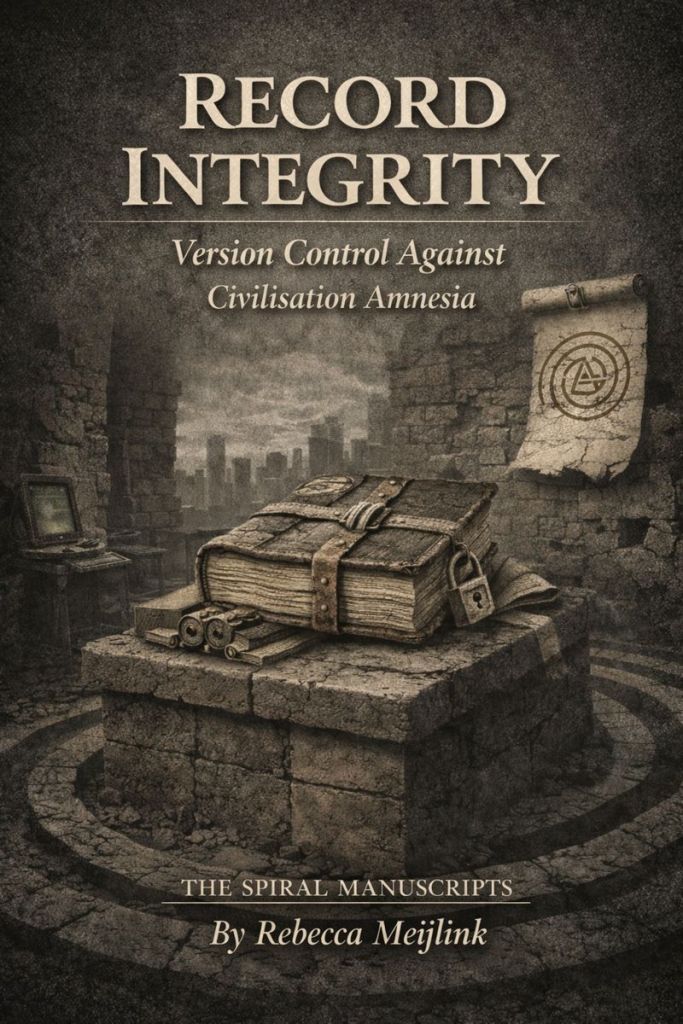
Civilisation is not losing information. It is losing the ability to retrieve what was said, under what conditions, and what would count as a correction. Claims drift. Conditions disappear. Summaries replace sources. Excerpts replace arguments. Quiet edits erase audit trails. Accountability dissolves—not through censorship, but through compression. Record Integrity names this failure and provides the countermeasure.
This book shows how meaning is routinely stolen without changing words, how critique is neutralised into principles, and how institutions absorb language while deleting constraints. It then offers installable record infrastructure: naming and version rules, change logs, citation discipline, excerpt wrappers, releases indexes, and correction protocols that preserve meaning under pressure.
This is not a book about persuasion or narrative. It is a procedural manual for anyone whose work enters durable contexts—publication, policy, governance, media, standards, or institutions. Without record discipline, gates decay, corrections become rewrites, and history becomes negotiable. Record integrity is how meaning survives time.
Order your copy on Amazon: https://amzn.eu/d/2X3tU4O
Trust In an Age of Rational Distrust
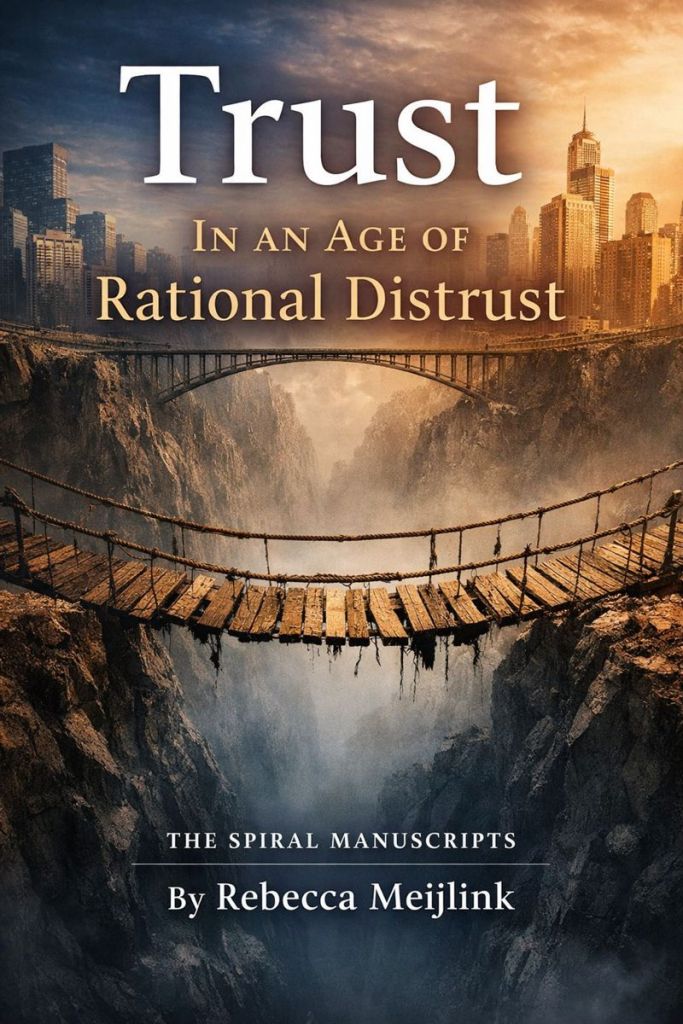
You were told your problem was “trust issues”. You were told you are guarded, negative, damaged, over-analysing. The world around you suggests the opposite: collapsing institutions, performative workplaces, weaponised vulnerability, and people who treat your nervous system as free infrastructure for their lives.
This book starts from a blunt premise: in a low-trust world, your suspicion is not a flaw. It is data. The question is not how to make you more trusting. The question is how to make your distrust more intelligent.
This book shows you how to treat trust as architecture, not virtue. Instead of asking “do I trust them?”, you learn to ask: what can I trust them with, at what scale, under which incentives, and with what exits. You will see why default trust has collapsed, how “trust issues” got turned into a convenient diagnosis, and how to stop paying the price for other people’s patterns with your body, time, money and future.
This is not a book about “learning to open your heart”. It is a manual for people who have seen enough to know that blind trust is expensive and global cynicism is a dead end. You will leave with a sharper map of who has earned what level of access to your life – and the tools to design trust in love, work, and systems on rational terms, not wishful.
Trust will never make you safe. Used properly, it can make you coherent.
Order your copy on Amazon: https://amzn.eu/d/aj9iXCF
How Stories Blind You to Reality

You don’t live in reality. You live in the story your mind tells you about it. You have a story about who you are, what always happens to you, what money means, what love is, and what your country is becoming. You have stories about your family, your ex, your boss, your “calling”, your nervous system, your future. Some of those stories are useful. Most are expensive. They keep you in relationships you know are done because “we’ve been through so much”. They keep you loyal to organisations that run on theatre while burning you out. And, they keep you convinced that your life is “complicated” when, structurally, three simple things are happening on repeat.
This book is not interested in your narrative. It is interested in the conditions underneath it. Across work, love, health, politics and self-image, How Stories Blind You to Reality shows you:
- How to spot when you have drifted into plot instead of contact
- How to distinguish one-off drama from actual patterns
- How to see the incentives and architectures hiding behind slogans, roles, and feelings
- How to make small, boring moves that quietly change your life more than another breakthrough ever will
You will not emerge with a better story about yourself. You will emerge with fewer illusions, cleaner leverage, and a simple operating rule: When story and reality disagree, reality wins.
Order your copy on Amazon: https://amzn.eu/d/6NxQBPQ
THE EUPHEMISM DICTIONARY OF POWER: A decoder for the phrases used across governments, corporates, NGOs, tech, and media
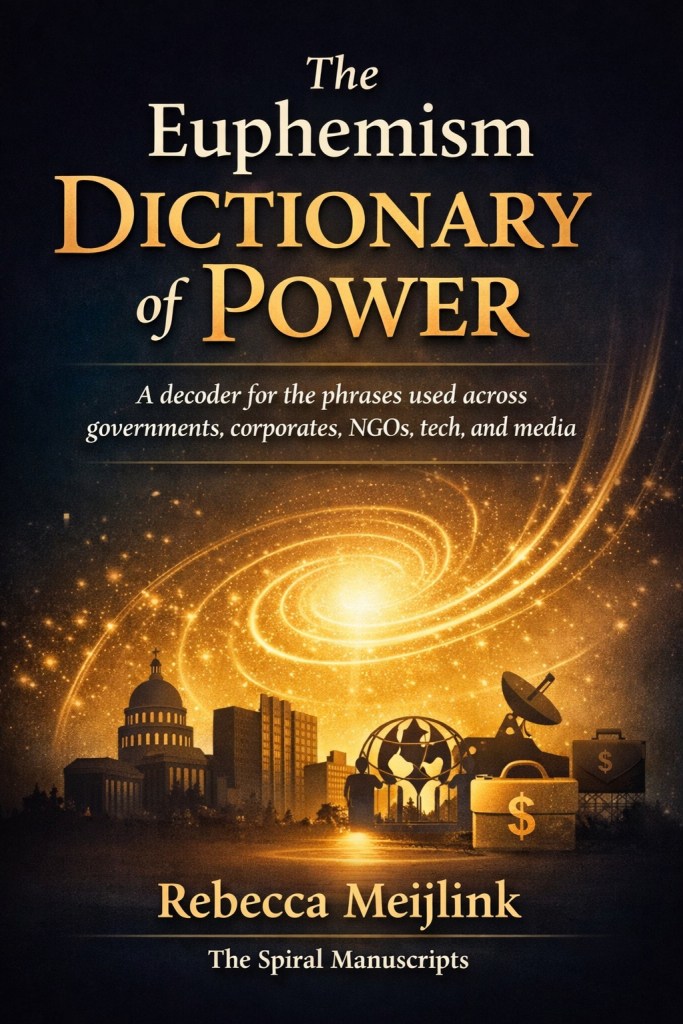
George Orwell wasn’t being dramatic; he was describing a mechanism. Nineteen Eighty-Four gave the world “Newspeak”: language engineered to shrink thought and pre-empt dissent.
Today’s version is rarely a single vocabulary imposed from above. It is a distributed dialect spoken across institutions — government briefings, corporate statements, NGO reports, platform policies, compliance frameworks, and media scripts. Power rarely announces itself as power. It arrives as “stability”, “support”, “orderly markets”, “best practice”, “risk-based”, “stakeholder”, “guardrails”, “public interest”, “tough decisions”, and “out of an abundance of caution”. The language sounds responsible. The function is often extraction, delay, liability shielding, or quiet transfer of cost to people who cannot refuse.
This book is a field manual for reading institutional English with the sentiment stripped out. Inside, you will find a clear, repeatable decoding method and a core dictionary of phrases. Each entry shows what the phrase usually does, what it hides, who benefits, who pays, and what questions expose the real mechanism. It is designed for real-world use: in boardrooms, policy briefings, investor updates, press conferences, HR meetings, compliance theatre, and crisis PR. If you’ve ever felt yourself being talked into agreement by words that don’t cash out into accountable action, this is your decoder.
Order your copy on Amazon: https://amzn.eu/d/6MhZsa3
Coherence Under Constraint

We notice prisons because the walls are visible, but confinement didn’t end at the gate; it permeated everyday life — debt loops, hospital wards, domestic duties, corporate procedures, and algorithmic time. Coherence Under Constraint reframes confinement as a measurable state, rather than a moral label: when mobility, choice, or feedback are reduced, the signal-to-noise ratio changes. Systems either stabilise or fragment. This book shows how to design limits that teach rather than bruise.
You’ll get an operator’s toolkit: a four-point functional test (freedom, feedback, time, identity), an eight-metric measurement kit (decision latency, feedback lag, conflict half-life, exception load, attention stability, autonomy, identity compression, rhythm stability), and field protocols for ethics, rights, re-entry, and daily operations. Case files span monasteries, ICU wards, prisons, classrooms, corporate turnarounds, and submarine crews. Digital confinement — notifications, reputation traps, 24/7 presence — is treated with the same discipline. No sentiment, no theatre. Clear transfer rules name what travels from cells to civil life (rhythm, plain signal, proportion) and what must never move (coercion, surveillance, scarcity fetish).
For leaders, clinicians, educators, governors, and carers, this is a manual for humane limits that end on time — and a governance model that stops exporting harm to the future. Keep the signal honest. Keep time bounded. Keep identity human.
Order your copy on Amazon: https://amzn.eu/d/50IazDy
 The Spiral Manuscripts