
Domestic Infrastructure: House, Health, Family & Cats
These books sit inside the most underestimated layer of civilisation: the domestic layer. Not politics, not institutions, not “the economy” in the abstract—home infrastructure. The place where nervous systems either recover or get quietly degraded.
Where health is made or unmade long before a clinic is involved. Where children learn what “normal” feels like. Where money becomes either a tool or a substitute for safety. Where clothing signals status, compliance, and identity before a word is spoken. Where food cravings reveal stress architecture. Where animals read the room more accurately than the humans do.
This shelf is applied coherence to the household. If you can’t build coherence here, you won’t build it anywhere else, because this is where your attention, energy, and decision quality are generated.
The books below take everyday domains—health, family, diet, money, fashion, home design, and the living field of animals—and treat them as systems: signals, contracts, loops, thresholds, and environments that either stabilise you or bleed you. They do not sell guilt, hacks, or perfect lives. They show you how to read your own conditions, stop paying the incoherence tax, and rebuild the small architectures that quietly run everything.
Scalar Health: The Body as Interface, Not Machine – Reframing illness, diagnosis, and healthcare as field phenomena in a world still treating humans as spare parts
Health has been turned into a private morality test. If you are ill, you should have eaten better, slept more, managed stress, thought positively, bought the right supplements, followed the right protocol. When that fails, you are handed labels and pills by systems that are themselves exhausted, fragmented and built around throughput rather than care. Your body is treated as a machine that keeps “letting you down”.
This book starts from a different premise: your body is an interface, not a machine. It is negotiating air, noise, light, food systems, work patterns, housing, digital feeds, medicine, money and politics in real time. Symptoms are not abstract glitches; they are signals about what those fields are doing to you.
Scalar Health: The Body as Interface, Not Machine lays out a clear, unsentimental framework for understanding illness, chronic conditions and burnout without collapsing into either self-blame or helplessness. It shows how diagnosis, risk scores, hospitals, pharmaceuticals, wellness culture, “helpers” and self-help all act as fields around your nervous system – and how to work with them without being swallowed by them.
This is not a list of hacks or a promise that you can “heal anything”. It is a manual for operating a human body in a non-linear world: mapping your actual life, identifying real leverage points, rejecting shame you do not own, and viewing health as infrastructure, not as a character flaw. The body was never the enemy. It has been telling the truth about our civilisation all along.
Order your copy on Amazon: https://amzn.eu/d/0QyGsqn
Scalar Families: Parenting, Partnership and Belonging in a Fractured Field
Families are not mysteries or moral tests; they are systems running on contracts most people never see.
Scalar Families shows you how those contracts actually work – around love, money, bodies, conflict, divorce, estrangement, ageing and death – and what happens when one person quietly stops renewing the worst of them.
This is not a book about “perfect parenting” or “healing your lineage.” It is a manual for running a liveable home in a fractured century: fewer lies in the kitchen, cleaner endings, better repair, and children who do not have to spend half their adult life unpicking what you refused to name.
This work sits in visionary non-fiction and applied systems thinking. It treats family life as a live system of nervous systems and contracts, not as psychology manual, therapeutic guide, or spiritual teaching. It is written for operators – parents, partners, and adults running households – and is intended for reflection and structural change, not diagnosis or therapy.
Order your copy on Amazon: https://amzn.eu/d/aJnwvVg
Craving Control: How to Rewire Your Brain So Sweets and Pizza Stop Running the Show
Cravings are not random, and they are not a moral verdict on your character. They are the visible end of an architecture: how you sleep, how you fuel, how much stress your nervous system is carrying, and how your environment has been set up to win against you. This book treats sweets and pizza as data, not sin. When they keep winning, it means the system underneath them is doing exactly what it was built to do.
You will not find before-and-after photos or a six-step miracle. What you get instead is a way of reading your own loops: when cravings show up, what state you are in, what story you tell yourself, and how your current setup practically guarantees the same outcome tomorrow. From there, you start altering the architecture. The book includes a simple six-week plan that is built for real life, not a fantasy one.
This book is one node in The Spiral Manuscripts library, which rebuilds systems from the nervous system to the organisation, nation, and planet. Once you can see cravings as an architecture problem, you have learned a pattern you can apply everywhere else including money and relationships.
Order your copy on Amazon: https://amzn.eu/d/975hMHm
The True Work of Money: How to Rewire Emotional Loops into Coherent Capital
Money is not love, status, safety, or validation. It is a coordination instrument. Yet people, companies, and governments use it as a substitute nervous system, trying to regulate fear, shame, envy, and belonging with numbers in an account.
The result is predictable: revolving debt, compulsive consumption, hoarding that never feels safe, corporate theatre, sovereign borrowing spirals, and a planetary economy treating the biosphere as a limitless credit line.
This book names that mistake and rebuilds the architecture from the ground up. It starts at the individual level: mapping your dominant emotional loops, designing finishable safety thresholds, repair-before-lifestyle rules, restoration and autonomy bands, and clear routes for surplus into capability and mission. The same grammar is then scaled to organisations, nations, and the planetary system, so you can read any balance sheet or budget as a loop map – and use money as a clean tool for repair, resilience, and coherent capital.
Order your copy on Amazon: https://amzn.eu/d/7XEaTDO
The Signal Wardrobe: How Fashion Programs Identity, Status, and Behaviour
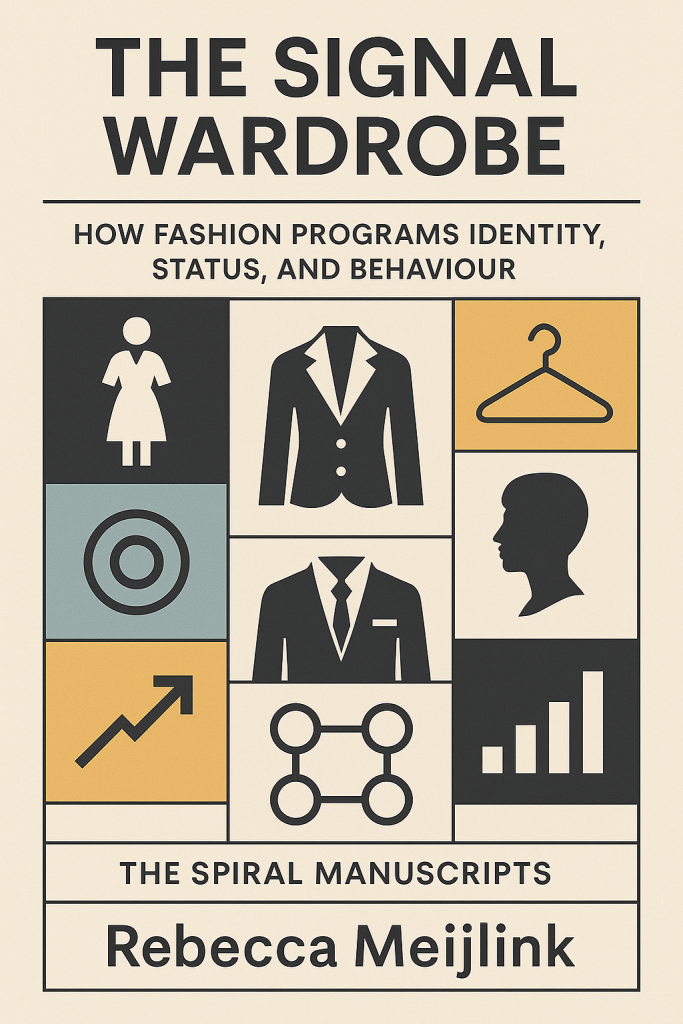
Fashion isn’t decoration. It’s governance. Before you speak, your clothes have already negotiated your status, safety, credibility, and belonging. In a world of weak institutions and constant visibility, wardrobes have become compliance systems: you buy signals to avoid downgrade, to look “right”, to remain legible, to survive the feed.
The bookdismantles fashion as a signalling infrastructure—not taste, not self-expression, but a behavioural economy that programs identity and monetises instability. It shows how trends spread as field waves, how “quiet luxury” functions as elite camouflage, why sustainability fails when it doesn’t replace the status payload, and how dress codes and “appropriateness” quietly enforce class and obedience.
Then it rebuilds the system: status substitutes, a coherence model for clothing, and concrete actions brands and governments can actually take—without theatre, guilt campaigns, or pretending humans will stop signalling. If you’ve ever felt that your wardrobe is running you rather than serving you, this book hands you the map—and the exit.
Order your copy on Amazon: https://amzn.eu/d/aXMonJS
The Room Is Never Neutral: Cat Rules for Calm Living
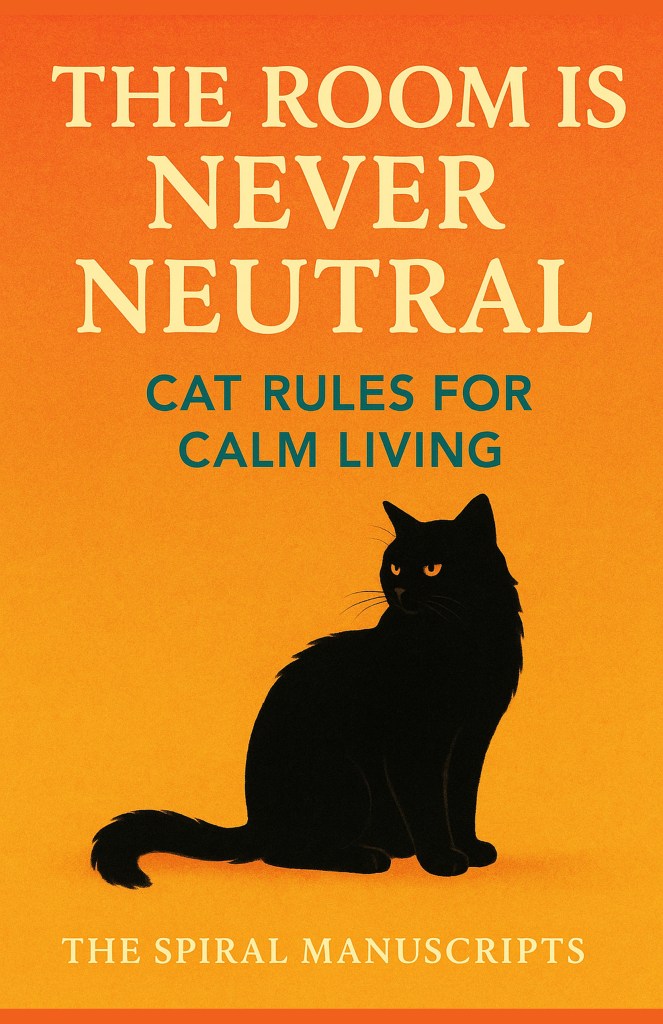
The room is never neutral—and your cat proves it daily. This practical guide translates everyday feline habits into simple home protocols that make rooms calmer and people softer. You will learn how purring acts as a low-frequency carrier for relaxation, why thresholds, corners, and vertical perches change behaviour, and how small shifts in light, sound, placement, and timing turn “aloof” into affectionate. Built for busy households (kids, guests, WFH, renovations), it shows where food, water, and litter actually belong, how to create a reliable evening settle, and what to do when a cat suddenly moves away, avoids one person, or chooses to sleep on you. Repeatable roomcraft you can test tonight. The result: a house that learns, a cat that stays, and a family that rests.
Scope: a behavioural/household guide, not veterinary advice. For health issues, consult your vet.
Order your copy on Amazon: https://amzn.eu/d/fnF1zfS
The Scalar Cat: Field Literacy in a Feline Body

Cats aren’t mystical ornaments or tiny tyrants. They’re field instruments—reading rooms, stabilising households, and broadcasting coherence at 25–150 Hz. This book makes that legible and usable. You’ll see why a cat chooses the “wrong” chair, sleeps on your chest after conflict, refuses one room, or purrs at illness and death—and how to engineer a home that stops fighting its operator. No sentimentality: biology, behaviour, and scalar logic translated into practical moves. Contracts, not ownership. Thresholds, not corridors. Purr as carrier wave, not myth. For guardians, rescuers, behaviourists, and systems thinkers who want better outcomes—and calmer rooms—starting tonight.
In practice, this book will help you: understand where your cat sits and why, stop breaking the contracts that make them leave, read illness and behaviour as field data, and redesign your house so everyone’s nervous system works less.
Scope: a behavioural/household guide, not veterinary advice. For health issues, consult your vet.
Order your copy on Amazon: https://amzn.eu/d/d9fgkpr
THE WORLD THAT HUMS, 18 Tales of Quiet Magic

The world hums quietly. Can you hear it?
For 7-12 years. Eighteen modern fables invite readers to slow down and listen to the sound between things — where wind finds its tune, mountains remember to breathe, and kindness glows like light in water.
Each story is a small act of resonance: simple enough for children, deep enough for any age that has forgotten stillness. Read them aloud. Leave space between sentences. Watch how silence changes shape.
Each of the eighteen fables in The World That Hums teaches a different dimension of coherence, resonance, and field awareness — but always through simple emotional truth. These are not moral tales in the traditional sense; they are tuning stories. Each one reintroduces a way of perceiving balance, timing, and relational intelligence — what might be called scalar literacy, translated into child-scale experience.
The World That Hums teaches not with rules but with rhythm. It helps families rediscover the gentle intelligence of calm attention — the place where breath, story, and the living world meet.
Across all tiers, the fables quietly teach scalar awareness: that attention, rhythm, and tone alter reality. They dismantle the industrial, noise-based model of intelligence — achievement, control, speed — and replace it with coherence literacy: awareness of how harmony forms through relational timing.
Children learn to feel truth rather than define it. Adults rediscover that silence is participatory, not empty. Together, they experience reading as tuning — where story, breath, and the living world become one continuous hum.
Order your copy on Amazon: https://amzn.eu/d/8bIQqNh
Search ‘Rebecca Meijlink’ on Amazon — all publications are available there.
Important Notice: By continuing to browse this site, you confirm that you are over 18 and have read and accepted the Legal Notice & Disclaimer at https://spiralmanuscripts.com/legal-notice-disclaimer-terms-of-engagement/
 The Spiral Manuscripts