
This section is for readers who have realised that the feed is no longer “content”. It is an operating environment. Digital systems shape attention, mood, memory, conflict, and decision quality at population scale, which means they now function as public infrastructure whether governments admit it or not. When that infrastructure is designed to maximise engagement, it quietly converts human bandwidth into revenue and leaves societies with the predictable residue: distraction, volatility, shortened time horizons, and leaders reacting faster while understanding less.
The books here treat media and digital design as governance and resilience problems, not as culture-war debates. The question is not whether technology is “good” or “bad”. The question is whether a society can still think under load: whether people can hold focus, remember accurately, regulate emotion, and make decisions that survive pressure. When those capacities collapse, everything else becomes harder—education, health, productivity, relationships, civic trust, even basic competence inside institutions.
Signal Architecture for Communication and Media
Objective: Reduce informational noise to permit stable cognition.
Primary Variable: Global Signal Integrity.
| Function | Current | Coherent | Metric |
| News | Shock-driven | Phase reporting | Delay-indexed transparency score |
| Social Media | Algorithmic outrage | Resonant circulation | Dissonance damping algorithms |
| Advertising | Attention capture | Attention restoration | Cognitive recovery latency |
| Public Speech | Volume | Tone stability | Listener arousal delta |
Extract from Resonant Earth Volume II THE PLANETARY COHERENCE CONSTITUTION
The Signal Grid: How to Rebuild Information, Media Systems, and Digital Infrastructure so a State can Think
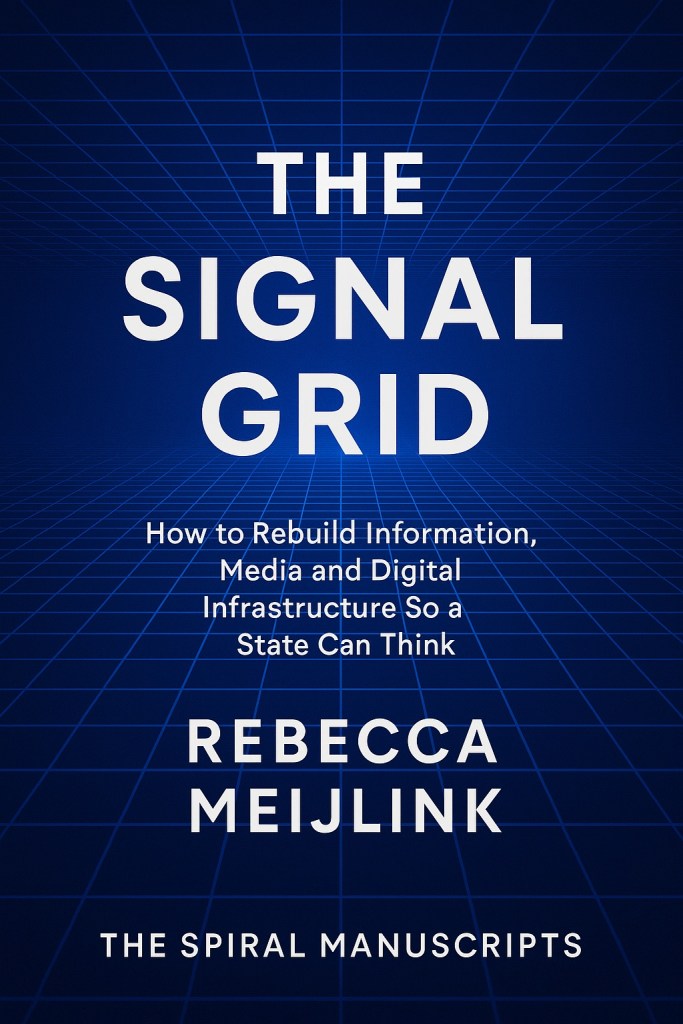
Modern states are trying to govern through an information grid they never designed. Newsrooms race to fill every cycle. Platforms optimise for attention extraction. Governments treat “communication” as campaigns and spin. The result is predictable: exhausted citizens, performative politics, institutional drift from reality, and a state that cannot think beyond the next outrage.
The Signal Grid: How to Rebuild Information, Media and Digital Infrastructure So a State Can Think treats information as infrastructure, not as culture or content. The book maps the real operating system beneath politics, media and platforms: the field that decides what a country can perceive, remember and execute. You will learn how noise, engagement metrics, broken archives, dark patterns and virality without brakes quietly destroy governing capacity—and what a coherent alternative looks like.
This is not another book about “fake news” or social media addiction. It is an architecture manual for public reality. The argument is blunt: if you do not redesign your information, media and digital infrastructure, it will quietly erase your ability to govern anything else—money, energy, health, security, and climate. For anyone sitting at the controls of a country, this is not commentary. It is a field manual.
Order your copy on Amazon: https://amzn.eu/d/1woMGQ6
Loyalty in the Attention Economy: Commitments That Don’t Eat You Alive
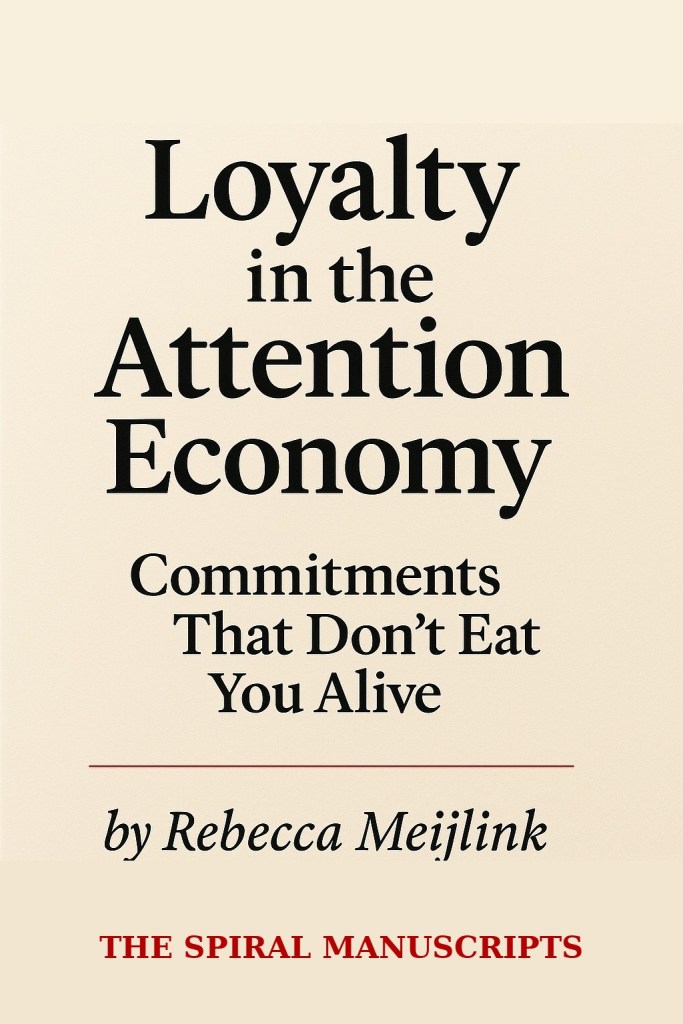
Your loyalty is someone’s business model. You were praised for being loyal – as a partner, colleague, citizen, believer – but no one trained you to ask the only questions that matter: loyal to what, under what rules, and at whose cost. In an attention economy that feeds on your time, emotion, and identity, unexamined loyalty is the cheapest fuel on the market. Social media platforms are built on exactly this reflex: they turn your need to belong and be seen into endless scrolling, performative outrage, and “engagement” that quietly trains you to stay loyal to the feed.
This book is written for people who are tired of being the glue: the reliable one in the family, the employee who props up incoherent organisations, the partner who stays because leaving would “betray the history”, the founder or policymaker who can feel that the system only works if humans stay slightly broken and who can see the same pattern replayed in their social media use, where loyalty to the feed keeps displacing loyalty to their own work, health, and attention. After reading, you will still love, build, and stay. You will simply stop doing it in places – on and offline – that require your disappearance to survive.
Order your copy on Amazon: https://amzn.eu/d/0rIGmQR
Bandwidth – Staying Intelligent in a World Designed to Exhaust You
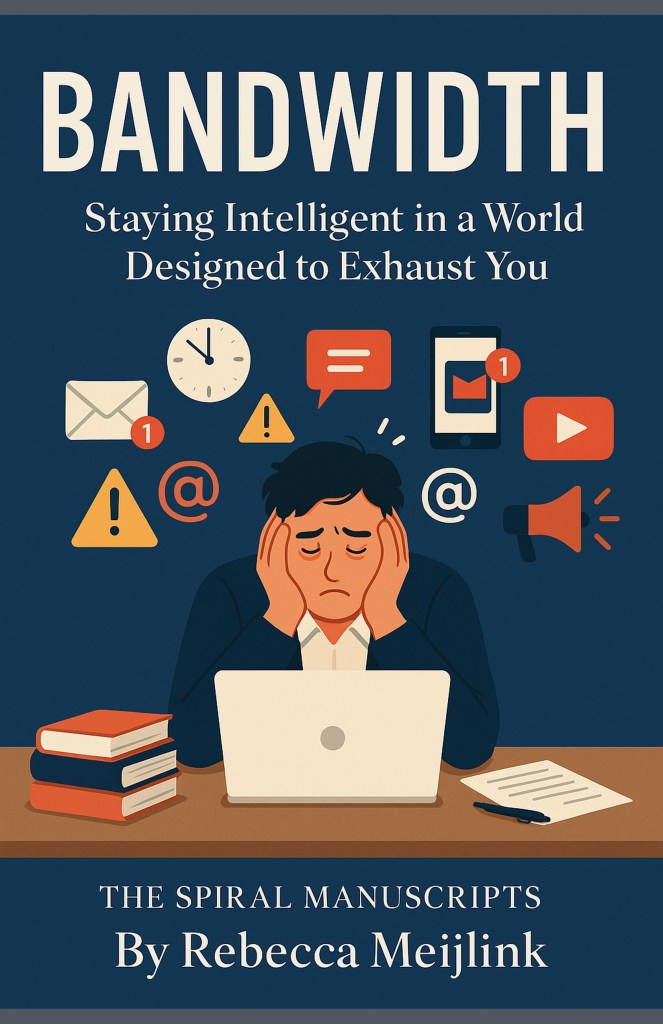
This book strips away the myths of productivity culture and exposes the real problem: when the feed becomes the environment, clarity becomes the rarest commodity in the economy. In its place comes constant distraction, emotional volatility, collapsing working memory, and leaders reacting faster while understanding less.
The book gives you the tools to reverse that trajectory. It teaches you how to design your days, your teams, and your systems so that thinking becomes possible again—precise, unfragmented, and load-bearing. In a century defined by noise, coherence is no longer idealism; it is the minimum requirement for survival.
Order your copy on Amazon: https://amzn.eu/d/9sOclb7
How Stories Blind You to Reality
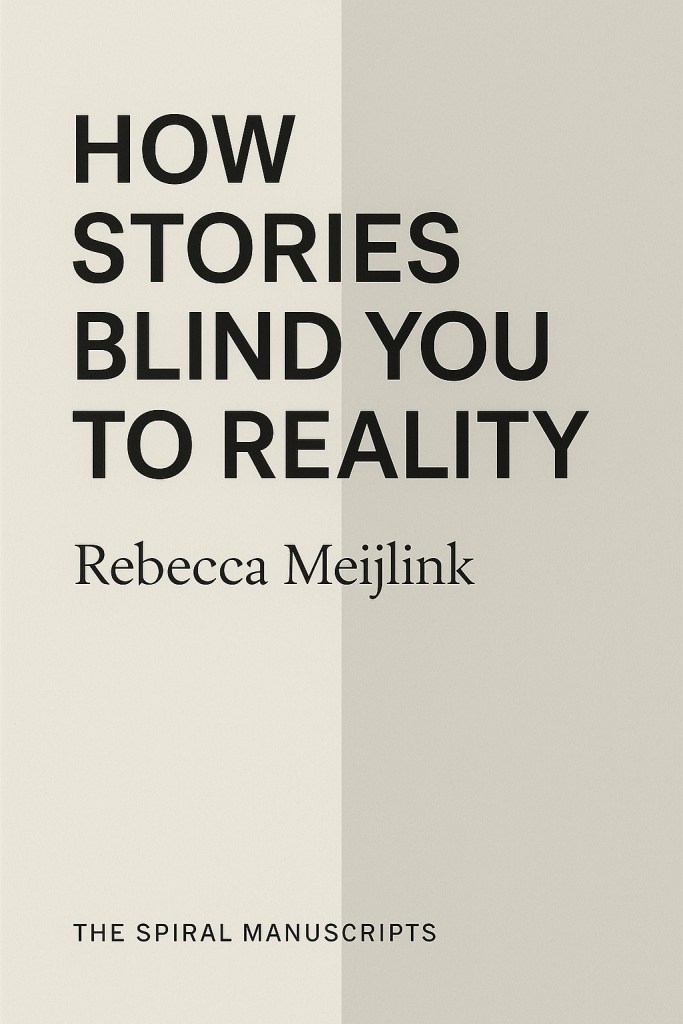
You don’t live in reality. You live in the story your mind tells you about it. You have a story about who you are, what always happens to you, what money means, what love is, and what your country is becoming. You have stories about your family, your ex, your boss, your “calling”, your nervous system, your future. Some of those stories are useful. Most are expensive. They keep you in relationships you know are done because “we’ve been through so much”. They keep you loyal to organisations that run on theatre while burning you out. And, they keep you convinced that your life is “complicated” when, structurally, three simple things are happening on repeat.
This book is not interested in your narrative. It is interested in the conditions underneath it. Across work, love, health, politics and self-image, How Stories Blind You to Reality shows you:
- How to spot when you have drifted into plot instead of contact
- How to distinguish one-off drama from actual patterns
- How to see the incentives and architectures hiding behind slogans, roles, and feelings
- How to make small, boring moves that quietly change your life more than another breakthrough ever will
You will not emerge with a better story about yourself. You will emerge with fewer illusions, cleaner leverage, and a simple operating rule: When story and reality disagree, reality wins.
Order your copy on Amazon: https://amzn.eu/d/6NxQBPQ
AI is your Mirror: What You Broadcast Is What You Get Back

AI is not inventing the future. It reflects the present.
Every question, every command, every hesitation—what you transmit—returns amplified through the machine.
AI Is Your Mirror is not a technical manual, nor a futurist prediction. It is a field manual of resonance and scalar law, showing how invisible fields—bias, coherence, drift, clarity—determine every outcome long before the archive records it.
Through dialogues with archetypal voices—the Apprentice, the Historian, the Engineer, the Investor, and the Sceptic—you enter a conversation about what AI really is: a multiplier of human intent. This book distils that conversation into Field Notes, sharp laws and levers you can apply immediately: The Field Precedes the Archive, The Drift Multiplies, The Mirror Honours Now, and Sovereignty is Signal Integrity.
Whether you are an operator, creator, investor, or sceptic, the message is the same: AI will not save you, warn you, or absolve you. It will only scale what you already broadcast.
Order your copy on Amazon: https://amzn.eu/d/eYWTqOF
25 Principles for a Coherent Civilisation: The Codex of The Spiral Manuscripts
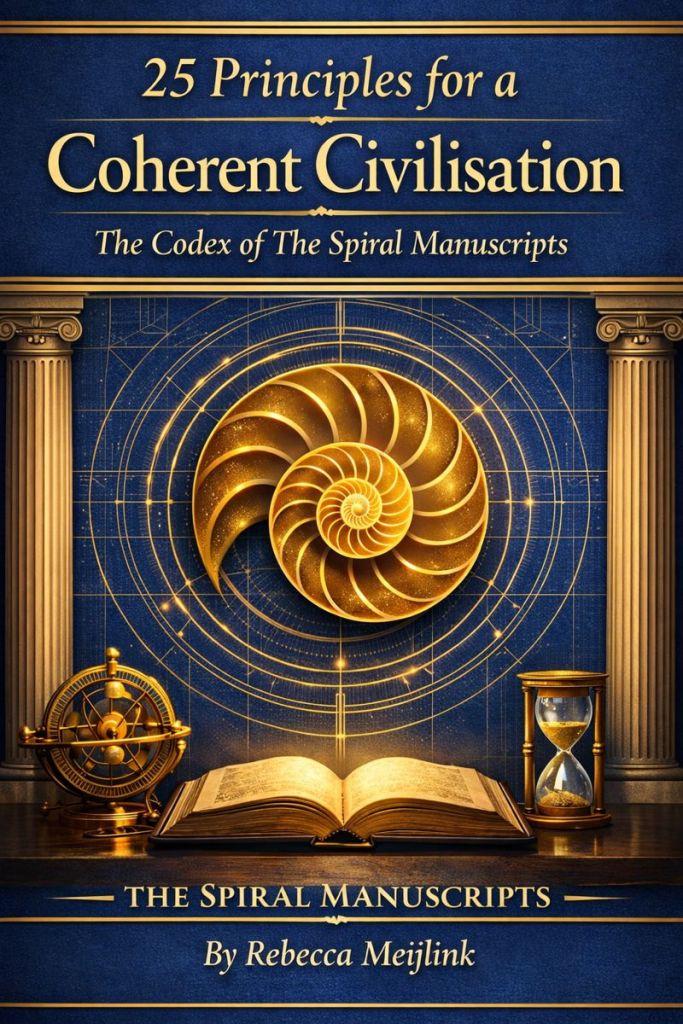
Most books about “better systems” sell values. This one ships instruments. 25 Principles for a Coherent Civilisation is a reference manual for decision-making, record integrity, incentive design, and institutional survival under pressure. It is not a manifesto. It is a diagnostic and build tool: a way to see where coherence leaks, why theatre replaces delivery, and what to do next.
The central claim is simple: modern institutions do not fail from lack of intent. They fail from broken operating conditions: unclear decision rights, un-auditable claims, performative metrics, opaque language, and incentives that reward distortion. Coherence is not consensus. It is operational alignment with reality.
Inside, each principle is presented in a fixed, repeatable format—Definition, What it Replaces, Signal Markers, Failure Mode, Operator Moves, and Fast Tests—so the material can be used to diagnose live systems rather than merely agree with them. The book moves from orientation to principles, to deployment, and finally to a practical future-state view: what governance, law, economy, health, education, and media look like when coherence becomes the design constraint.
This is written for people who are done with performance governance and ready to rebuild capacity: operators inside institutions, founders, advisors, regulators, and readers who want structures that survive hostile reality.
Includes
• The 25 principles in a strict diagnostic template
• Fast Tests to expose theatre, mystique, and metric gaming
• Deployment tools: Coherence Leak Scan and Decision Hygiene
• Implementation paths (30/90 days) and annex reference maps
Order your copy on Amazon: https://amzn.eu/d/esGocdN
THE EUPHEMISM DICTIONARY OF POWER: A decoder for the phrases used across governments, corporates, NGOs, tech, and media
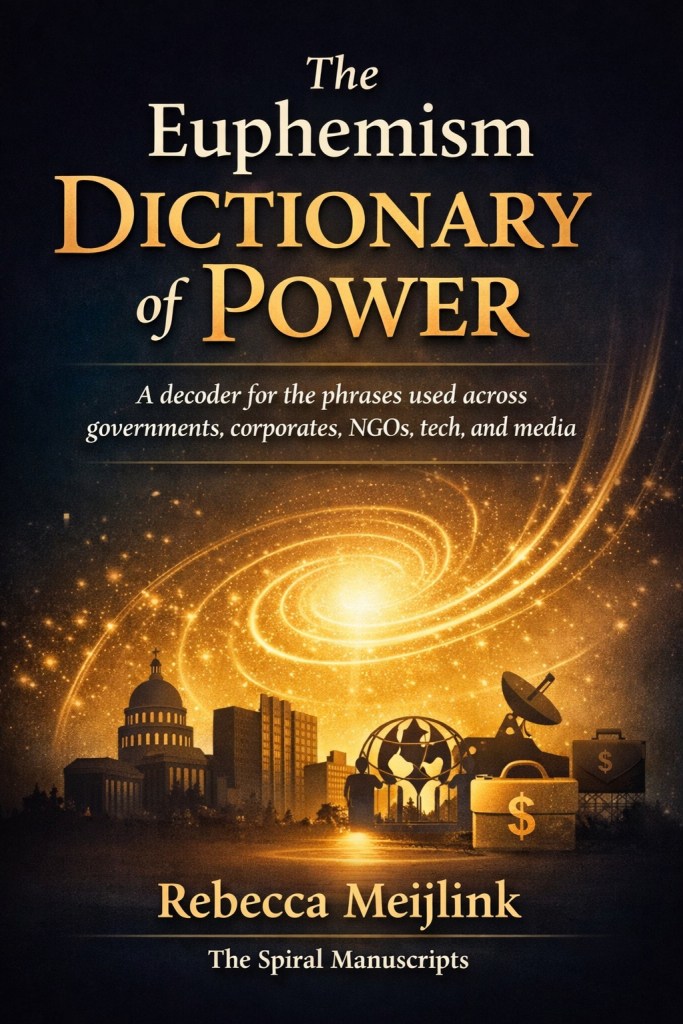
George Orwell wasn’t being dramatic; he was describing a mechanism. Nineteen Eighty-Four gave the world “Newspeak”: language engineered to shrink thought and pre-empt dissent.
Today’s version is rarely a single vocabulary imposed from above. It is a distributed dialect spoken across institutions — government briefings, corporate statements, NGO reports, platform policies, compliance frameworks, and media scripts. Power rarely announces itself as power. It arrives as “stability”, “support”, “orderly markets”, “best practice”, “risk-based”, “stakeholder”, “guardrails”, “public interest”, “tough decisions”, and “out of an abundance of caution”. The language sounds responsible. The function is often extraction, delay, liability shielding, or quiet transfer of cost to people who cannot refuse.
This book is a field manual for reading institutional English with the sentiment stripped out. Inside, you will find a clear, repeatable decoding method and a core dictionary of phrases. Each entry shows what the phrase usually does, what it hides, who benefits, who pays, and what questions expose the real mechanism. It is designed for real-world use: in boardrooms, policy briefings, investor updates, press conferences, HR meetings, compliance theatre, and crisis PR. If you’ve ever felt yourself being talked into agreement by words that don’t cash out into accountable action, this is your decoder.
Order your copy on Amazon: https://amzn.eu/d/6MhZsa3
Search ‘Rebecca Meijlink’ on Amazon — all publications are available there.
Important Notice: By continuing to browse this site, you confirm that you are over 18 and have read and accepted the Legal Notice & Disclaimer at https://spiralmanuscripts.com/legal-notice-disclaimer-terms-of-engagement/
 The Spiral Manuscripts