
Justice as a Nervous System: Law, Conflict and Loop Closure in a Coherent Society
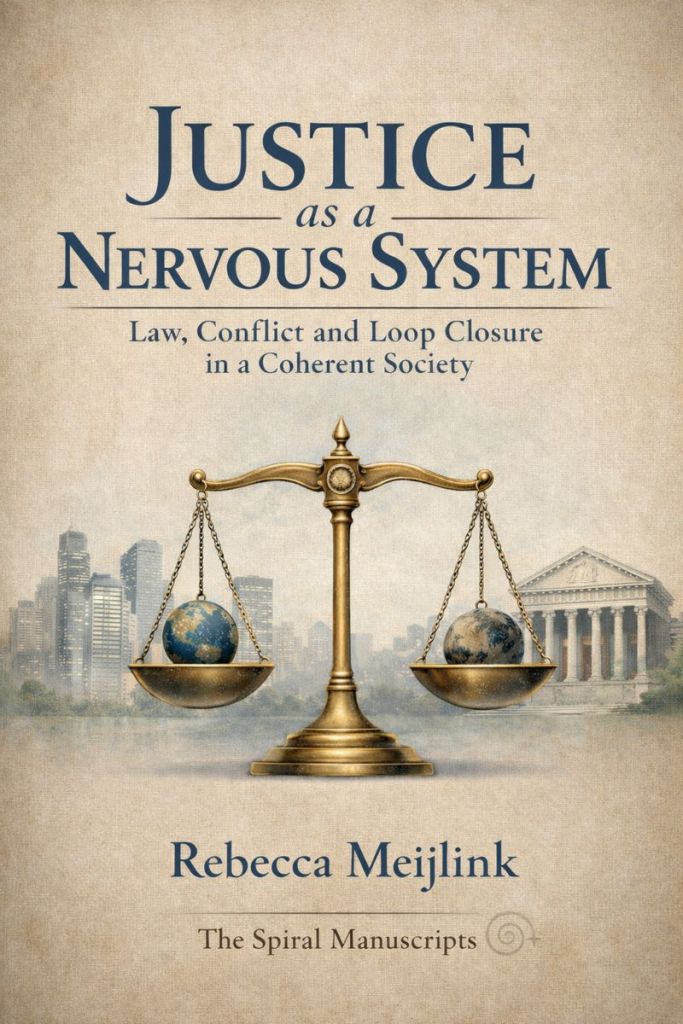
Most justice systems are built to process cases, not to close harm loops. They perform resolution on paper while leaving the underlying field unchanged: victims still unsafe, communities still distrustful, institutions still repeating the same failure patterns, and offenders returned to the same conditions with added distortion.
Justice as a Nervous System treats law as an operating system, not a morality play. It maps how harm moves through police, prosecutors, courts, prisons, regulators, HR departments, contracts, and grievance machinery, and why so much of that machinery rewards theatre, containment, and reputational defence over truth, repair, and prevention.
This is a structural manual for people who need justice systems to function under pressure: judges, lawyers, regulators, police leaders, policymakers, compliance and HR heads, board members, researchers, and anyone designing accountability inside real institutions.
If you want fewer speeches and more stopping power — mechanisms that change the field so the same harms stop recurring — this book gives you the architecture.
Order your copy on Amazon: https://amzn.eu/d/1xhnq63
Coherence Under Constraint

We notice prisons because the walls are visible, but confinement didn’t end at the gate; it permeated everyday life — debt loops, hospital wards, domestic duties, corporate procedures, and algorithmic time. Coherence Under Constraint reframes confinement as a measurable state, rather than a moral label: when mobility, choice, or feedback are reduced, the signal-to-noise ratio changes. Systems either stabilise or fragment. This book shows how to design limits that teach rather than bruise.
You’ll get an operator’s toolkit: a four-point functional test (freedom, feedback, time, identity), an eight-metric measurement kit (decision latency, feedback lag, conflict half-life, exception load, attention stability, autonomy, identity compression, rhythm stability), and field protocols for ethics, rights, re-entry, and daily operations. Case files span monasteries, ICU wards, prisons, classrooms, corporate turnarounds, and submarine crews. Digital confinement — notifications, reputation traps, 24/7 presence — is treated with the same discipline. No sentiment, no theatre. Clear transfer rules name what travels from cells to civil life (rhythm, plain signal, proportion) and what must never move (coercion, surveillance, scarcity fetish).
For leaders, clinicians, educators, governors, and carers, this is a manual for humane limits that end on time — and a governance model that stops exporting harm to the future. Keep the signal honest. Keep time bounded. Keep identity human.
Order your copy on Amazon: https://amzn.eu/d/50IazDy
The Cage Reflex: Why Civilisations Keep Needing Prisons and How to Replace Them
This book gives a field-level map of the cage reflex: the human habit of converting fear and distortion into removal, and mistaking that removal for safety.
You will recognise how punishment functions as a dopamine, closure ritual, a fast way to quiet internal disturbance without repairing what produced it and why reform fails whenever the reflex stays unnamed.
If you want to stop rebuilding cages in your relationships, your politics, your nervous system, and your future, this is a manual for making the reflex visible, stripping it of moral glamour, and learning what a coherent response to harm actually feels like.
Order your copy on Amazon: https://amzn.eu/d/4FBZpXG
25 Principles for a Coherent Civilisation: The Codex of The Spiral Manuscripts
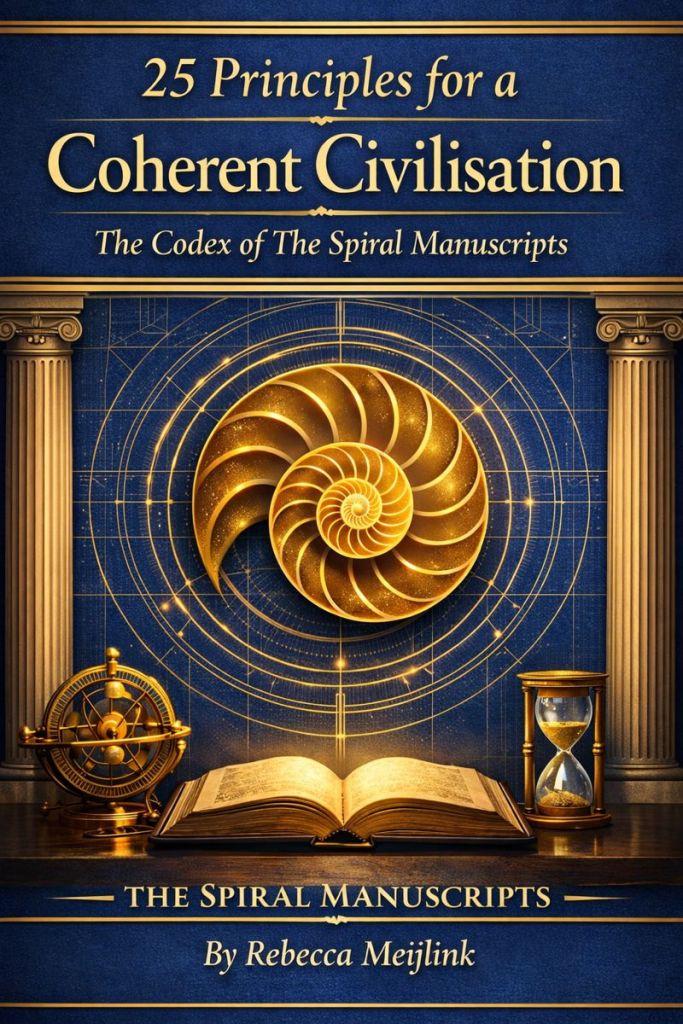
Most books about “better systems” sell values. This one ships instruments. 25 Principles for a Coherent Civilisation is a reference manual for decision-making, record integrity, incentive design, and institutional survival under pressure. It is not a manifesto. It is a diagnostic and build tool: a way to see where coherence leaks, why theatre replaces delivery, and what to do next.
The central claim is simple: modern institutions do not fail from lack of intent. They fail from broken operating conditions: unclear decision rights, un-auditable claims, performative metrics, opaque language, and incentives that reward distortion. Coherence is not consensus. It is operational alignment with reality.
Inside, each principle is presented in a fixed, repeatable format—Definition, What it Replaces, Signal Markers, Failure Mode, Operator Moves, and Fast Tests—so the material can be used to diagnose live systems rather than merely agree with them. The book moves from orientation to principles, to deployment, and finally to a practical future-state view: what governance, law, economy, health, education, and media look like when coherence becomes the design constraint.
This is written for people who are done with performance governance and ready to rebuild capacity: operators inside institutions, founders, advisors, regulators, and readers who want structures that survive hostile reality.
Includes
• The 25 principles in a strict diagnostic template
• Fast Tests to expose theatre, mystique, and metric gaming
• Deployment tools: Coherence Leak Scan and Decision Hygiene
• Implementation paths (30/90 days) and annex reference maps
Order your copy on Amazon: https://amzn.eu/d/esGocdN
THE EUPHEMISM DICTIONARY OF POWER: A decoder for the phrases used across governments, corporates, NGOs, tech, and media
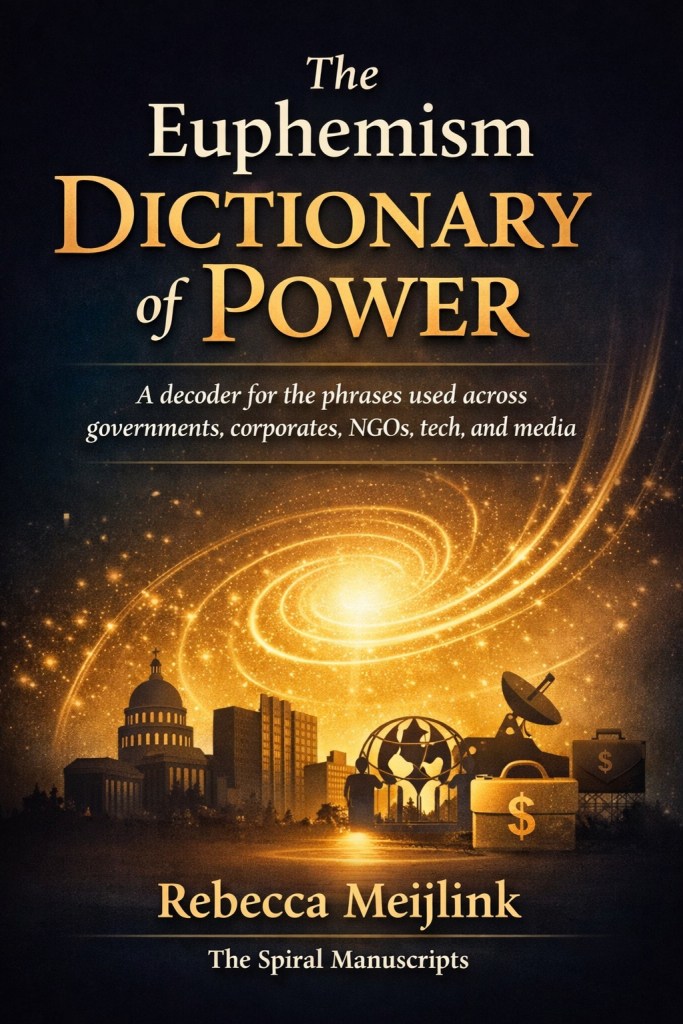
George Orwell wasn’t being dramatic; he was describing a mechanism. Nineteen Eighty-Four gave the world “Newspeak”: language engineered to shrink thought and pre-empt dissent.
Today’s version is rarely a single vocabulary imposed from above. It is a distributed dialect spoken across institutions — government briefings, corporate statements, NGO reports, platform policies, compliance frameworks, and media scripts. Power rarely announces itself as power. It arrives as “stability”, “support”, “orderly markets”, “best practice”, “risk-based”, “stakeholder”, “guardrails”, “public interest”, “tough decisions”, and “out of an abundance of caution”. The language sounds responsible. The function is often extraction, delay, liability shielding, or quiet transfer of cost to people who cannot refuse.
This book is a field manual for reading institutional English with the sentiment stripped out. Inside, you will find a clear, repeatable decoding method and a core dictionary of phrases. Each entry shows what the phrase usually does, what it hides, who benefits, who pays, and what questions expose the real mechanism. It is designed for real-world use: in boardrooms, policy briefings, investor updates, press conferences, HR meetings, compliance theatre, and crisis PR. If you’ve ever felt yourself being talked into agreement by words that don’t cash out into accountable action, this is your decoder.
Order your copy on Amazon: https://amzn.eu/d/6MhZsa3
Important Notice: By continuing to browse this site, you confirm that you are over 18 and have read and accepted the Legal Notice & Disclaimer at https://spiralmanuscripts.com/legal-notice-disclaimer-terms-of-engagement/
 The Spiral Manuscripts