
The Institute for Scalar Architecture & Civilisational Design (ISACD) is a research, training, and advisory institute focused on next-generation civilisation infrastructure. It exists for people who already understand that “transformation” is meaningless—personally and institutionally—if the underlying architecture does not change. ISACD does not optimise existing systems. It redesigns the structures they sit on.
ISACD works on the real drivers of modern breakdown: bandwidth failure in human systems, emotional illiteracy embedded in culture, institutional incoherence, and governance drift caused by architectures that cannot read their own operating conditions. The Institute replaces legacy, event-driven models with field-level operating frameworks for nations, organisations, and high-leverage decision-makers. ISACD is expected to launch in 2026.
The Institute designs and stress-tests architectures across governance, education, justice, finance, nervous-system infrastructure, and planetary decision systems. It trains practitioners to implement these architectures through field literacy (reading conditions, not headlines), coherence modelling (aligning incentives, capital, and behaviour), and recursive systems thinking (how local decisions propagate through larger systems).
ISACD is conceived as a structural upgrade to legacy institutions: the analytical discipline of a top consultancy, the research depth of a complexity institute, and the future-orientation of a technology lab—without political capture, extractive logic, or reputational signalling as the operating motive. The purpose is straightforward: to give serious operators tools to design systems that do not fail at the first real stress test.
Rebecca Meijlink is the intellectual engine: author of The Spiral Manuscripts and IP owner. AlphaBet Select Ltd is the operational engine: licensee and commercial operator. ISACD is the institutional engine.
ISACD delivers three categories of work.
Architectures
Blueprints for redesigning justice systems, education systems, financial instruments, governance models, and nervous-system infrastructure so they remain coherent under predictable stress.
Diagnostics
Tools to detect drift, incoherence, and bandwidth failure in institutions before they surface as public crises, reputational events, or “urgent transformations”.
Training
Field literacy and coherence training for operators who need to think at a civilisational scale without losing contact with human limits, incentives, and implementation realities.
Who It’s For
ISACD is for people who hold or shape real levers: senior policymakers, regulators, sovereign wealth and institutional capital allocators, board-level decision-makers, and system architects in education, justice, finance, health, and large-scale infrastructure.
If your decisions change rules, incentives, and architectures for more than a handful of people, you’re in scope. If you want a nicer leadership narrative or a “culture programme,” you are not.
What It Is and What It Isn’t
ISACD is
A research, design, and diagnostics institute for civilisation-scale systems, grounded in:
– human bandwidth limits and nervous-system constraints
– coherence dynamics across incentives, governance, and culture
– long-horizon stress and collapse conditions
ISACD is not
– a membership club or networking summit
– a policy-advocacy shop for a specific ideology
– theory without implementation pathways
– an annual-theme institute designed for media cycles
Frequently Asked Questions
Who is ISACD actually for?
A: ISACD is for people who already hold or shape real levers: senior policymakers, sovereign funds, regulators, institutional investors, and system architects in education, justice, finance, health, and large-scale infrastructure. If your decisions change rules, incentives, or architectures for more than a handful of people, you are our target audience. If you just want a nicer leadership quote deck, we are not a fit.
What do you actually deliver – in concrete terms?
A: Three things:
– Architectures: blueprints for how to structure justice systems, education systems, financial instruments, governance models, and nervous-system infrastructure so they do not collapse under predictable stress.
– Diagnostics: ways to read drift, incoherence, and bandwidth failure in institutions before they show up as public crises.
– Training: field literacy and coherence training for operators who need to think at a civilisational scale without losing contact with real human nervous systems.
Are you a think tank, a consultancy, or a school?
A: None and a bit of all three. We do original research like a think tank, design and advisory like a high-end consultancy, and training like a specialist school. The difference is our centre of gravity: we are not focused on policy memos, billable hours, or generic leadership courses. Everything revolves around one question: “Will this architecture still function when reality stops being polite?”
Are you politically aligned or partisan?
A: No. We are structurally biased in only one direction: towards architectures that remain coherent under stress and do not require constant propaganda to function. We will work with governments and institutions across the political spectrum if they are serious about redesigning systems, not just rebranding them. If the brief is “help us make our existing model look modern”, we decline.
Where does “scalar” come into this – is this spiritual?
A: No. “Scalar” here does not mean mystical energy. It refers to how patterns behave across scales—from body to institution to planet. We work with nervous systems, emotional patterns, incentives, and governance structures, but we do not sell metaphysics, rituals, or belief systems. Our job is to design systems that respect human limits and signal flows, not to tell anyone what to believe.
How is this different from hiring McKinsey / BCG / a big-name consultancy?
A: Large consultancies optimise around existing constraints: they help you do what you already do slightly better, faster, or more digitally. ISACD starts by questioning whether the underlying architecture is viable at all. We are not here to improve slide decks or restructure communications; we are here to ask, “Why does this system fail the same way every decade?” and then design something that does not. If you want safer versions of what you already have, hire them. If you want to rebuild from first principles, talk to us.
Do you work with companies, or only with governments and international organisations?
A: We work with any entity or individual whose decisions have a systemic impact. This may include governments, regulators, sovereign funds, large corporates, education systems, health systems, city-level governance, and occasionally mission-critical NGOs. For private companies, we are most relevant when you are effectively running public infrastructure (for example: platforms, finance, housing, food, media, education, health).
How do you use technology and AI in your work?
A: We treat technology and AI as amplifiers, not saviours. Our designs assume that any powerful tool will magnify both coherence and dysfunction. We do not sell “AI transformation”. We design architectures so that if you add heavy tech on top, you are not just accelerating collapse. Bandwidth, emotional literacy, and governance design come first; tooling comes after.
How do you get paid, and who owns the work?
A: ISACD will be funded through a mix of patrons, strategic partnerships, commissioned projects, and (over time) fellowships and training programmes. We do not operate on contingent fees or short-term political cycles. Ownership of specific deliverables is set out per engagement, but the underlying scalar frameworks and diagnostics remain with ISACD so they can be improved and reused across contexts.
When will ISACD be fully operational?
A: ISACD is expected to launch in 2026. The Spiral Manuscripts library acts as the R&D layer: the books are the public documentation of the frameworks. The institute is the implementation arm—where those frameworks are stress-tested with real systems, under real constraints, with operators who actually hold levers.
What ISACD is – and what it isn’t?
What ISACD is
The Institute for Scalar Architecture & Civilisational Design is a research, design, and diagnostics institute for civilisation-scale systems. It works on the redesign of the architecture of justice, education, finance, governance, health, and information systems, starting from:
– human nervous systems and bandwidth limits
– coherence and field dynamics
– long-horizon stress and collapse scenarios
ISACD produces:
– scalar blueprints for systems that can be implemented and audited
– diagnostic tools that map failure modes, loops, and coherence gaps
– operator training for people who design, regulate, or run large-scale systems
Its focus is simple: “How should systems be built and upgraded so they stay coherent under real stress?”
What ISACD is not
– Not a membership club or networking summit
– Not a policy-advocacy shop for a specific ideology
– Not a place for abstract theory with no implementation pathway
– Not oriented around annual themes, media cycles, or reputational signalling
ISACD is an architectural lab for operators: a place where entire systems get redesigned from first principles, tested against human bandwidth, and prepared for conditions far beyond the comfort zone of the current paradigm.
For institute enquiries, partnerships, or pilot conversations, please contact:
Rebecca Meijlink – rebecca@alphabetselect.com
Frequently Asked Questions
Who is ISACD actually for?
ISACD is for people who already hold or shape real levers: senior policymakers, sovereign funds, regulators, institutional investors, and system architects in education, justice, finance, health, and infrastructure. If your decisions change the operating conditions for many people, you are the target audience.
What do you actually deliver—concretely?
Three things: architectures (blueprints that can be implemented and audited), diagnostics (tools that map failure modes and coherence gaps), and training (field literacy and coherence modelling for operators implementing at scale).
Are you a think tank, a consultancy, or a school?
None and a bit of all three. ISACD does original research like a think tank, design and advisory like a high-end consultancy, and training like a specialist school. The centre of gravity is different: we are not oriented around memos, billable hours, or generic leadership content. We build architectures that function under stress.
Are you politically aligned or partisan?
No. ISACD is structurally biased in one direction only: towards architectures that remain coherent under stress and do not require propaganda to function. If the brief is “make the existing model look modern,” we decline.
Where does “scalar” come into this—is this spiritual?
No. “Scalar” refers to how patterns behave across scales—from nervous system to institution to nation to planet. ISACD does not sell metaphysics, rituals, or belief. It designs systems that respect human limits and signal flows.
How is this different from McKinsey / BCG / big consultancies?
Large consultancies optimise within existing constraints. ISACD starts by asking whether the underlying architecture is viable at all. If you want safer versions of what you already do, hire them. If you want first-principles redesign, talk to ISACD.
Do you work with companies or only governments and institutions?
ISACD works with any entity whose decisions have systemic impact: governments, regulators, sovereign funds, large corporates running public-like infrastructure (platforms, finance, housing, food, media, education, health), and select mission-critical organisations where architecture—not messaging—is the bottleneck.
How do you use technology and AI?
Technology and AI are treated as amplifiers, not saviours. ISACD designs governance and architecture so that adding powerful tools does not accelerate collapse. Bandwidth, emotional literacy, and governance come first. Tooling comes after.
How do you get paid, and who owns the work?
ISACD is funded through patrons, strategic partnerships, commissioned projects, and training programmes. Ownership of engagement deliverables is defined per contract. The underlying diagnostic frameworks and architectures remain with ISACD so they can be iterated, stress-tested, and improved over time.
When will ISACD be fully operational?
ISACD is expected to launch in 2026. The Spiral Manuscripts library is the public R&D layer: the frameworks documented in books. The institute is the implementation arm: stress-testing under real constraints with operators who hold levers.
Enquiries
For institute enquiries, partnerships, or pilot conversations:
Rebecca Meijlink — rebecca@alphabetselect.com
Think Big, Think Scalar: Stop Performing Vision. Start Rebuilding Reality.
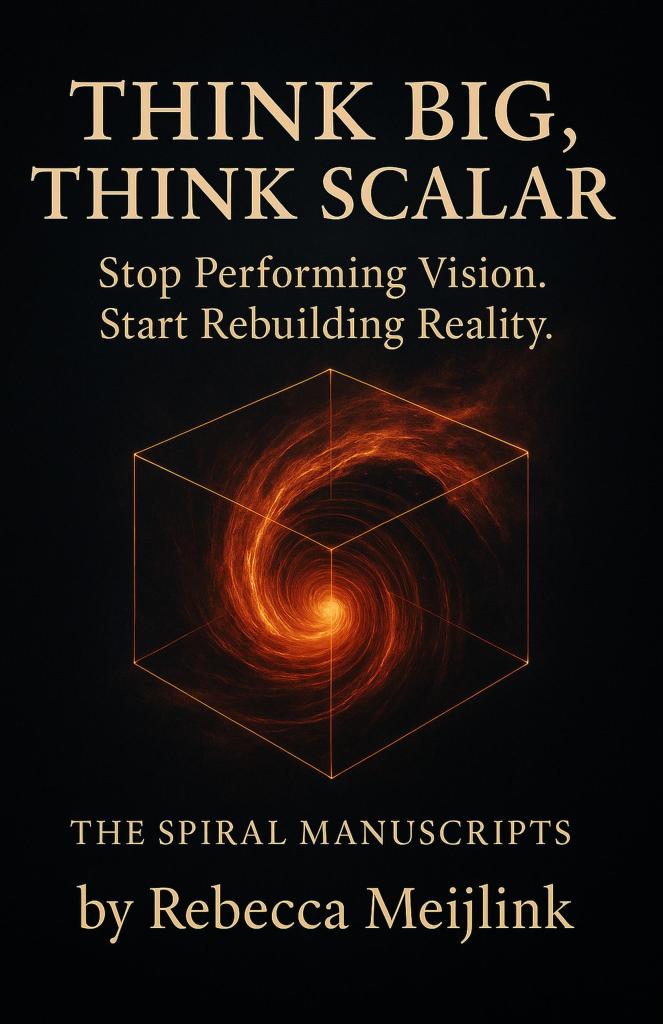
Most books tell you to “think big” without asking whether the architecture you live in can hold anything truly different. Think Big, Think Scalar starts there: your potential is not small; the systems around you are. The book shows how families, careers, organisations, and institutions quietly train you into underuse while congratulating you for being “responsible” and “realistic”.
You are given a scalar lens: fields instead of events, loops instead of isolated failures, drift instead of random outcomes, bandwidth as infrastructure rather than a private struggle. With that in hand, the book walks through real domains – money, education, governance, organisations – and shows how most “big ideas” die because they never touch incentives, ownership, or governance. It dismantles transformation theatre and explains why systems keep producing the same crises even when clever, well-intentioned people are in charge.
Order your copy on Amazon: https://amzn.eu/d/drIcJv4
 The Spiral Manuscripts