
These three books belong together because they name the same bottleneck from different angles: modern life is being run above capacity. Not just in hospitals or budgets, but in bodies and institutions. When human bandwidth is eroded, everything downstream becomes unstable—decision quality, social trust, productivity, governance, care, and the ability to recover after shock. We are not short of information. We are short of nervous system capacity.
Industrial thinking still treats health as a sector: a ministry, a service, a waiting list, a spend line. That framing is convenient because it contains responsibility. It allows societies to argue about “healthcare” while ignoring the upstream conditions that manufacture illness and crisis. But health is an output of an environment. It is what happens when housing, work, streets, digital systems, bureaucracy, and financial pressure collide with human physiology. Hospitals count the score.
The Healthy Nation-State takes this seriously at state scale. It treats a country as a nervous-system architecture and argues that resilience lives in the bandwidth of its people and the thickness of its social floor. If either is eroded, no amount of messaging, policing, or clinical throughput can hold the system together for long.
Scalar Health: The Body as Interface, Not Machine pulls the same idea into the personal frame. It rejects the cultural habit of turning illness into private moral failure, and instead treats the body as an interface negotiating real-world conditions in real time. It is not a promise of miracles. It is a different way of reading what symptoms and breakdown are pointing to.
Bandwidth in the Body is the practical anchor: an operating lens on capacity, collapse, and rebuild. It is written for people who are tired of being told their limits are a mindset problem, and who want a more structural understanding of why coherence fails under load.
You can read these books in any order. The throughline is simple: health is not a side topic. It is the operating limit of civilisation. Treat it as infrastructure, or watch systems keep failing in predictable ways.
The Healthy Nation-State – Nervous Systems, Social Floors, and the Real Resilience of the State
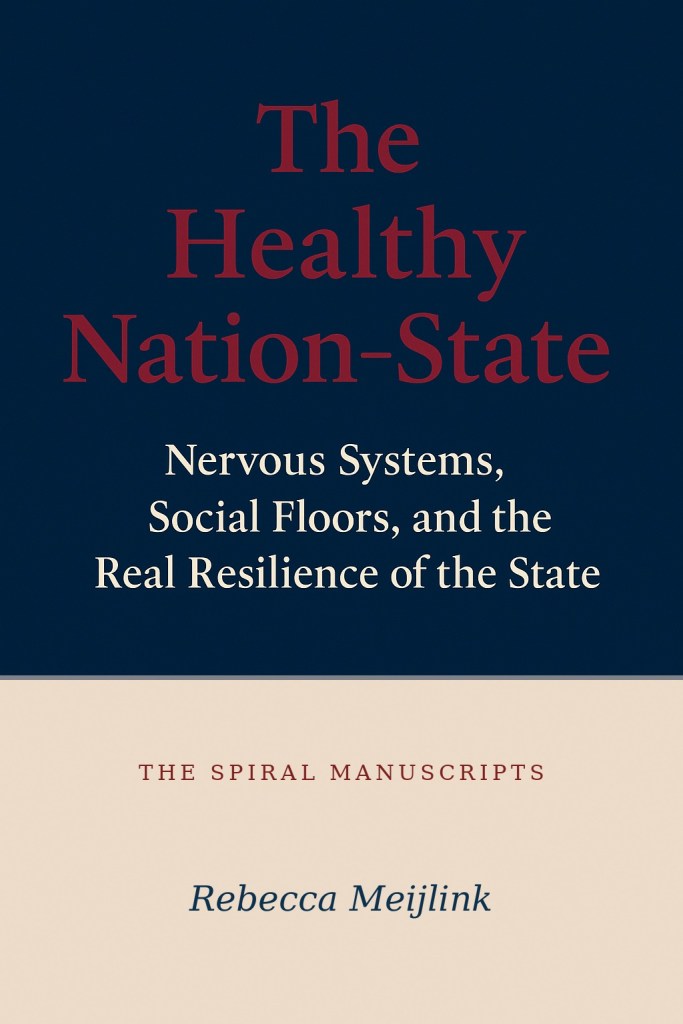
We keep pretending health is a sector. It isn’t. Health is what happens when a nation’s housing, labour market, streets, digital systems, institutions and budgets collide with human nervous systems. Hospitals count the score.
This book treats a country as a nervous-system architecture. It argues that the real resilience of a nation-state lives in two places: the bandwidth of its people and the thickness of its social floor. If those are eroded, no amount of clinical capacity, policing or communications strategy can hold the system together for long.
Drawing on stress physiology, social-determinants research and statecraft, this bookmaps how noise, time poverty, unstable housing, precarious work, hostile bureaucracy and extractive digital design quietly structure illness and crisis. It then shows what a state would look like if it took nervous systems and floors as seriously as it takes GDP and bond yields.
This is a structural proposal: treat health as the operating limit of your civilisation, redesign the architecture accordingly, or watch your institutions run out of human bandwidth to govern with. If you work anywhere near the levers of a state, this is your manual.
Order your copy on Amazon: https://amzn.eu/d/gxDn20w
Scalar Health: The Body as Interface, Not Machine – Reframing illness, diagnosis, and healthcare as field phenomena in a world still treating humans as spare parts
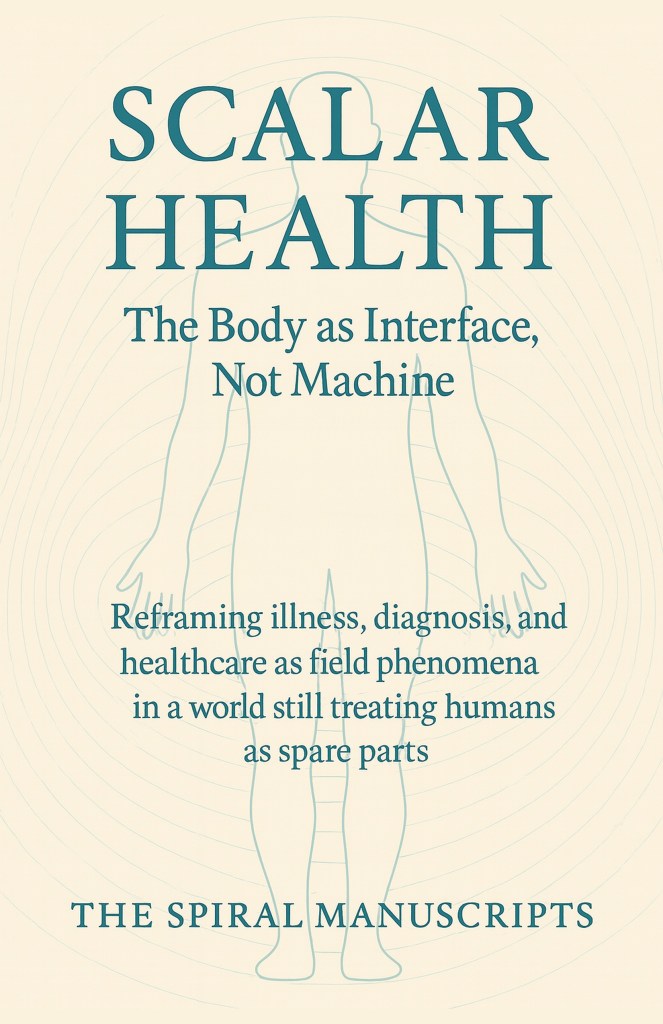
Health has been turned into a private morality test. If you are ill, you should have eaten better, slept more, managed stress, thought positively, bought the right supplements, followed the right protocol. When that fails, you are handed labels and pills by systems that are themselves exhausted, fragmented and built around throughput rather than care. Your body is treated as a machine that keeps “letting you down”.
This book starts from a different premise: your body is an interface, not a machine. It is negotiating air, noise, light, food systems, work patterns, housing, digital feeds, medicine, money and politics in real time. Symptoms are not abstract glitches; they are signals about what those fields are doing to you.
Scalar Health: The Body as Interface, Not Machine lays out a clear, unsentimental framework for understanding illness, chronic conditions and burnout without collapsing into either self-blame or helplessness. It shows how diagnosis, risk scores, hospitals, pharmaceuticals, wellness culture, “helpers” and self-help all act as fields around your nervous system – and how to work with them without being swallowed by them.
This is not a list of hacks or a promise that you can “heal anything”. It is a manual for operating a human body in a non-linear world: mapping your actual life, identifying real leverage points, rejecting shame you do not own, and viewing health as infrastructure, not as a character flaw. The body was never the enemy. It has been telling the truth about our civilisation all along.
Order your copy on Amazon: https://amzn.eu/d/0QyGsqn
Bandwidth in the Body: The 8-Layer Nervous System Stack Behind Clarity, Collapse and Coherence

Most people think their problem is only mindset, motivation, or discipline. They’re wrong.
Your nervous system—your bandwidth—is the real operating system of your life. And for most people, it’s running at 40–50% capacity while being pushed to work at 120%. That gap is where burnout, bad decisions, emotional chaos, collapsing relationships, and incoherent life paths come from.
This book gives you the full architecture: the 8-Layer Human Bandwidth Stack. It explains why your spine, breathing, autonomic state, sensing accuracy, body map, DMN access, coherence layer, and action layer rise or fall together. When the lower layers collapse, the higher layers—intuition, clarity, foresight, boundaries, long-term decision-making—go offline. This is a mechanical operating manual for a human nervous system in the 21st century.
You will learn:
- Why your body is the real gatekeeper of intelligence
- How threat distorts perception, memory, and decision quality
- How loops, contradictions, and incoherent relationships drain bandwidth silently
- How collapse actually unfolds—and how to rebuild after it
- How to design a life that returns bandwidth instead of extracting it
- How to run a realistic 30-day reboot that your system can actually tolerate
If you want to think clearly, feel accurately, repair relationships, make serious decisions, or stop running your life through adrenaline and self-betrayal—this book gives you the map and the levers.
Order your copy on Amazon: https://amzn.eu/d/gB5R5lv
25 Principles for a Coherent Civilisation: The Codex of The Spiral Manuscripts
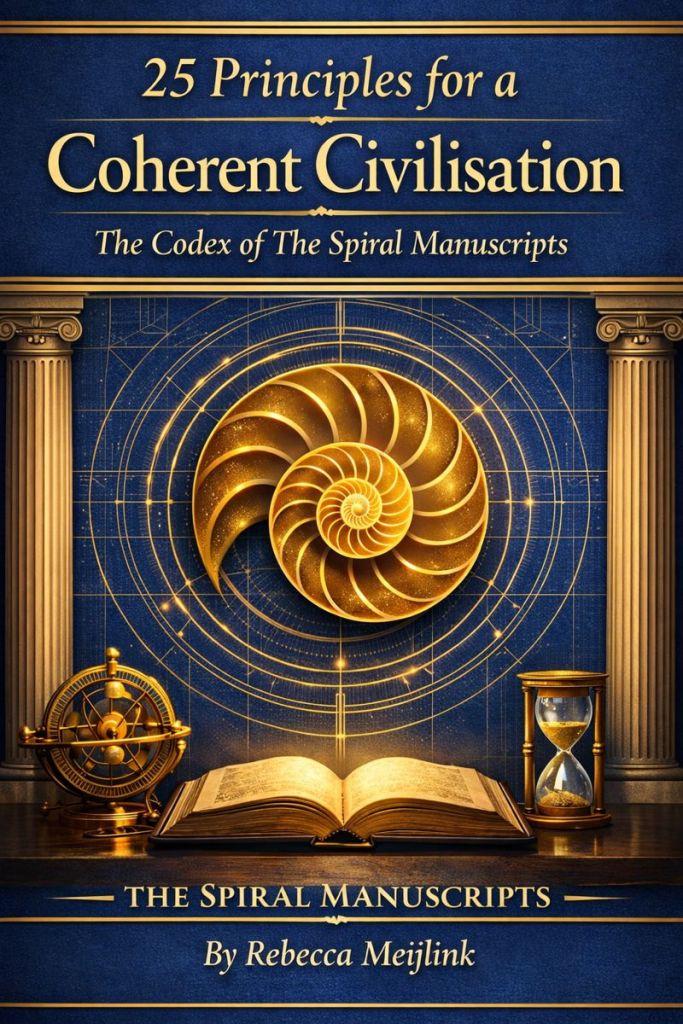
Most books about “better systems” sell values. This one ships instruments. 25 Principles for a Coherent Civilisation is a reference manual for decision-making, record integrity, incentive design, and institutional survival under pressure. It is not a manifesto. It is a diagnostic and build tool: a way to see where coherence leaks, why theatre replaces delivery, and what to do next.
The central claim is simple: modern institutions do not fail from lack of intent. They fail from broken operating conditions: unclear decision rights, un-auditable claims, performative metrics, opaque language, and incentives that reward distortion. Coherence is not consensus. It is operational alignment with reality.
Inside, each principle is presented in a fixed, repeatable format—Definition, What it Replaces, Signal Markers, Failure Mode, Operator Moves, and Fast Tests—so the material can be used to diagnose live systems rather than merely agree with them. The book moves from orientation to principles, to deployment, and finally to a practical future-state view: what governance, law, economy, health, education, and media look like when coherence becomes the design constraint.
This is written for people who are done with performance governance and ready to rebuild capacity: operators inside institutions, founders, advisors, regulators, and readers who want structures that survive hostile reality.
Includes
• The 25 principles in a strict diagnostic template
• Fast Tests to expose theatre, mystique, and metric gaming
• Deployment tools: Coherence Leak Scan and Decision Hygiene
• Implementation paths (30/90 days) and annex reference maps
Order your copy on Amazon: https://amzn.eu/d/esGocdN
THE EUPHEMISM DICTIONARY OF POWER: A decoder for the phrases used across governments, corporates, NGOs, tech, and media

George Orwell wasn’t being dramatic; he was describing a mechanism. Nineteen Eighty-Four gave the world “Newspeak”: language engineered to shrink thought and pre-empt dissent.
Today’s version is rarely a single vocabulary imposed from above. It is a distributed dialect spoken across institutions — government briefings, corporate statements, NGO reports, platform policies, compliance frameworks, and media scripts. Power rarely announces itself as power. It arrives as “stability”, “support”, “orderly markets”, “best practice”, “risk-based”, “stakeholder”, “guardrails”, “public interest”, “tough decisions”, and “out of an abundance of caution”. The language sounds responsible. The function is often extraction, delay, liability shielding, or quiet transfer of cost to people who cannot refuse.
This book is a field manual for reading institutional English with the sentiment stripped out. Inside, you will find a clear, repeatable decoding method and a core dictionary of phrases. Each entry shows what the phrase usually does, what it hides, who benefits, who pays, and what questions expose the real mechanism. It is designed for real-world use: in boardrooms, policy briefings, investor updates, press conferences, HR meetings, compliance theatre, and crisis PR. If you’ve ever felt yourself being talked into agreement by words that don’t cash out into accountable action, this is your decoder.
Order your copy on Amazon: https://amzn.eu/d/6MhZsa3
Search ‘Rebecca Meijlink’ on Amazon — all publications are available there.
Important Notice: By continuing to browse this site, you confirm that you are over 18 and have read and accepted the Legal Notice & Disclaimer at https://spiralmanuscripts.com/legal-notice-disclaimer-terms-of-engagement/
 The Spiral Manuscripts