
When strategy, capital, and people run on different clocks, organisations pay for it in slow decisions, rework, missed quarters, and talent drain—the standard incoherence tax. Executive strategy and leadership built on a single, coherent operating frame corrects this.
The books in this section give you tools to redesign that frame: how decisions are made, how risk is read, how alignment is created and maintained. If you apply the models rather than just read them, you should see concrete effects: lower decision latency, fewer exceptions, clearer accountability, and more predictable delivery under pressure.
The Coherent CEO: Strategy, Capital, and People on One Frequency (2025)
Most companies don’t fail because the idea was weak. They fail because the signal was. Strategy says one thing, capital funds another, people hear a third, customers are promised a fourth, regulators get a fifth. The CEO spends the year firefighting the consequences of that spread. The Coherent CEO is the operating doctrine for stopping it. It shows how to run a single frequency through a modern enterprise — from board and investors to sales, product, risk, regulators, M&A and crisis — so that decisions land the first time and stay landed.
Readers get a working operating system for the top job. They learn how to compress strategy into something the whole company can actually execute, how to force capital to follow that strategy, and how to hire and promote only people who can transmit it. They see how to stop customers, regulators, M&A, and boards from pulling the firm off-course, and how to use crisis to prove the signal instead of panicking. In short: fewer initiatives, fewer meetings, fewer surprises — and markedly faster throughput on what actually matters. This is coherence as a CEO-level performance tool.
Order your copy on Amazon: https://amzn.eu/d/iQQEDs7
THE EUPHEMISM DICTIONARY OF POWER: A decoder for the phrases used across governments, corporates, NGOs, tech, and media
George Orwell wasn’t being dramatic; he was describing a mechanism. Nineteen Eighty-Four gave the world “Newspeak”: language engineered to shrink thought and pre-empt dissent.
Today’s version is rarely a single vocabulary imposed from above. It is a distributed dialect spoken across institutions — government briefings, corporate statements, NGO reports, platform policies, compliance frameworks, and media scripts. Power rarely announces itself as power. It arrives as “stability”, “support”, “orderly markets”, “best practice”, “risk-based”, “stakeholder”, “guardrails”, “public interest”, “tough decisions”, and “out of an abundance of caution”. The language sounds responsible. The function is often extraction, delay, liability shielding, or quiet transfer of cost to people who cannot refuse.
This book is a field manual for reading institutional English with the sentiment stripped out. Inside, you will find a clear, repeatable decoding method and a core dictionary of phrases. Each entry shows what the phrase usually does, what it hides, who benefits, who pays, and what questions expose the real mechanism. It is designed for real-world use: in boardrooms, policy briefings, investor updates, press conferences, HR meetings, compliance theatre, and crisis PR. If you’ve ever felt yourself being talked into agreement by words that don’t cash out into accountable action, this is your decoder.
Order your copy on Amazon: https://amzn.eu/d/6MhZsa3
25 Principles for a Coherent Civilisation: The Codex of The Spiral Manuscripts
Most books about “better systems” sell values. This one ships instruments. 25 Principles for a Coherent Civilisation is a reference manual for decision-making, record integrity, incentive design, and institutional survival under pressure. It is not a manifesto. It is a diagnostic and build tool: a way to see where coherence leaks, why theatre replaces delivery, and what to do next.
The central claim is simple: modern institutions do not fail from lack of intent. They fail from broken operating conditions: unclear decision rights, un-auditable claims, performative metrics, opaque language, and incentives that reward distortion. Coherence is not consensus. It is operational alignment with reality.
Inside, each principle is presented in a fixed, repeatable format—Definition, What it Replaces, Signal Markers, Failure Mode, Operator Moves, and Fast Tests—so the material can be used to diagnose live systems rather than merely agree with them. The book moves from orientation to principles, to deployment, and finally to a practical future-state view: what governance, law, economy, health, education, and media look like when coherence becomes the design constraint.
This is written for people who are done with performance governance and ready to rebuild capacity: operators inside institutions, founders, advisors, regulators, and readers who want structures that survive hostile reality.
Includes
• The 25 principles in a strict diagnostic template
• Fast Tests to expose theatre, mystique, and metric gaming
• Deployment tools: Coherence Leak Scan and Decision Hygiene
• Implementation paths (30/90 days) and annex reference maps
Order your copy on Amazon: https://amzn.eu/d/esGocdN
Think Big, Think Scalar: Stop Performing Vision. Start Rebuilding Reality.
Most books tell you to “think big” without asking whether the architecture you live in can hold anything truly different. Think Big, Think Scalar starts there: your potential is not small; the systems around you are.
The book shows how families, careers, organisations, and institutions quietly train you into underuse while congratulating you for being “responsible” and “realistic”.
You are given a scalar lens. The book walks through real domains – money, education, governance, organisations – and shows how most “big ideas” die because they never touch incentives, ownership, or governance. It explains why systems keep producing the same crises even when clever, well-intentioned people are in charge.
Order your copy on Amazon: https://amzn.eu/d/drIcJv4
How to Think Like an Aviator in a Rail-Built World

How to Think Like an Aviator in a Rail-Built World
You were not born to live on rails. You were trained to. School, careers, family expectations and “being realistic” all quietly assume you are cargo on an industrial timetable called a life. The problem is no longer your effort or discipline. The problem is that the world now behaves like air, and you are still being asked to move like a train.
This book is written as The Aviator Manual for real operators – founders, senior professionals, policymakers, advisors, and independents. You will recognise the feeling of rails failing underneath you while everyone around you still treats the timetable as sacred.
Instead of mindset hacks, this book shows you how to treat your life as an aircraft: your nervous system as the cockpit; time, money, health and attention as systems to configure; relationships and work as architecture, not destiny. You will learn to spot where your current setup is built for captivity rather than range, to distinguish real risk from inherited fear, and to stop calling bad architecture “fate”. At the back of the book, you’ll find compact flight cards and checklists you can run in minutes – tired, overloaded, in love or under pressure – so this does not stay as theory you admire and forget. If you are done being rail cargo with opinions and ready to live as the operator of your own aircraft, this is your manual.
Order your copy on Amazon: https://amzn.eu/d/8oO49py
Scalar Governance: Why Politics Fails and Architecture Wins
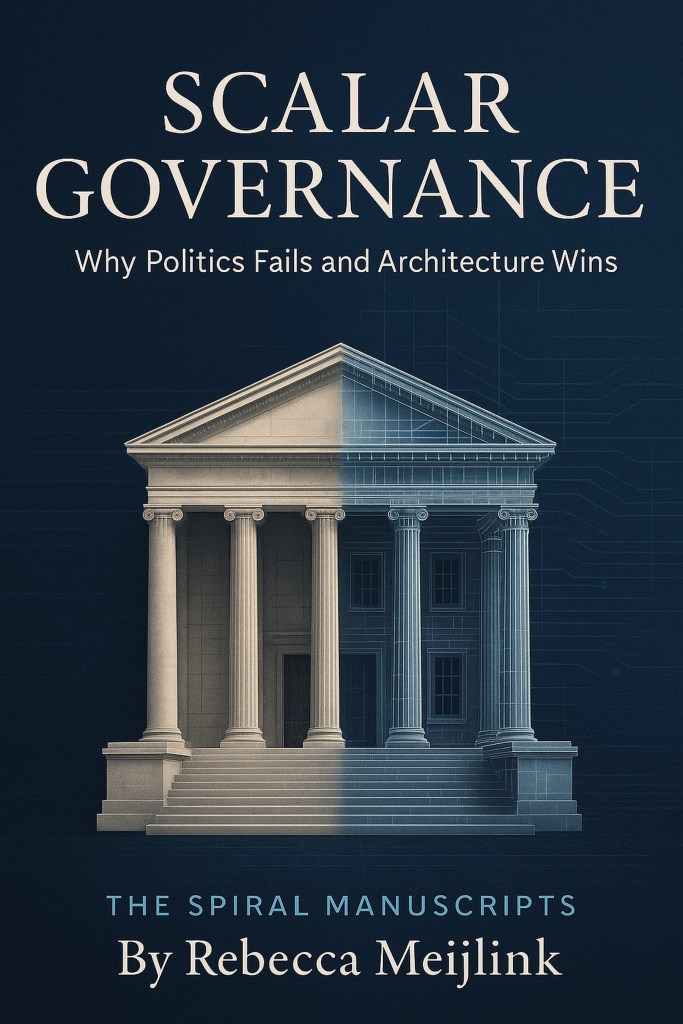
For executives, board members, and senior public leaders, Scalar Governance is the missing bridge between strategy slides and real-world behaviour. It explains why organisations and states keep defaulting to the same failure patterns, even when leaders are competent and intentions are good. The book treats governance as an operating system rather than a talking point, helping leaders see where their strategies clash with incentives, where their organisations run on human exhaustion instead of architecture, and where their reforms touch only the interface. It is a field manual for leaders who want coherence at the institutional, not just team, level.
Order your copy on Amazon: https://amzn.eu/d/8HS0jg4
Field Literacy: How to Read the World as a System

Field Literacy teaches a skill our civilisation forgot — how to read reality as relation, not as thing. Every modern problem — from burnout to political polarisation — begins with perceptual error: we were trained to think in lines while the world behaves as a field. You will transition from managing departments to leading fields; fewer surprises, faster recovery from shocks.
This book retrains attention to perceive pattern, feedback, and coherence across every system — biological, social, psychological, and technological. It shows how emotion becomes data, language becomes calibration, and perception itself becomes governance.
Through lucid prose and disciplined analysis, Field Literacy translates systems theory and neuroscience into plain English, offering a framework for living intelligently inside complexity. It is a manual for reading the world before it collapses under your noise. You will start to read market and organisational signals at a signal level.
“The world is not made of things but of relations.”
Order your copy on Amazon: https://amzn.eu/d/8tzEHR5
Coherence Business Models for the Present Economy (2025)

Following the vision mapped in Frequencies of Capital, this book moves from theory to practice. Where Frequencies of Capital diagnosed the collapse of the old grid, this volume provides the working blueprint for operating within the existing one.
In a world addicted to speed, coherence has become the rarest form of intelligence. Coherence Business Models for the Present Economy is a manual for those who sense that acceleration is no longer an advantage but noise. It shows how clarity, rhythm, and integrity have replaced growth, disruption, and efficiency as the true levers of performance.
Drawing on scalar field theory, systems science, and practical finance, the book translates resonance into business architecture. It demonstrates how trust, attention, and emotional tone behave like currencies—and how the organisations that measure them will define the next decade.
Across four parts—The Coherent Entrepreneur, Field Architecture for Business, Industry Applications, and The Operator Economy—a complete operating system is presented for commerce that functions at the frequency of truth. Each chapter closes with an executable “Now Business Model,” turning insight into immediate infrastructure: coherence indices, resonance-based accounting, board dashboards, credit clearinghouses, and coherence-weighted investment funds.
This is not another vision of the future. It is a working blueprint for the present—where calm becomes capital and coherence outperforms chaos. Profit as clarity. Leadership as frequency. Business at resonance.
Order your copy on Amazon: https://amzn.eu/d/391Lvuh
The Next Upgrade is not Digital – it’s Human

Field Training for a Quantum World — Transform your Mind for Quantum Logic, Realigning with the Universe, and Keeping Sovereignty Intact
We engineered faster systems. Built neural nets. Trained AI.
But forgot the one system that truly governs reality: the human field. This book is a recalibration device for an accelerating civilisation. Quantum systems are not coming—they’re already here. But they do not run on logic. They run on coherence. Which means the next breakthrough isn’t technological. It’s perceptual. Your nervous system is the interface. Your perception is the code. And your coherence is no longer optional.
This is an operator manual for reality under quantum load. Learn why field literacy—not processing power—will define who thrives. This is your invitation to deprogram outdated scripts, recode your signal, and stabilise as a quantum-native human being. The upgrade is not in the cloud. It’s in your body.
Order your copy on Amazon: https://amzn.eu/d/5QAlrRl
Bandwidth – Staying Intelligent in a World Designed to Exhaust You
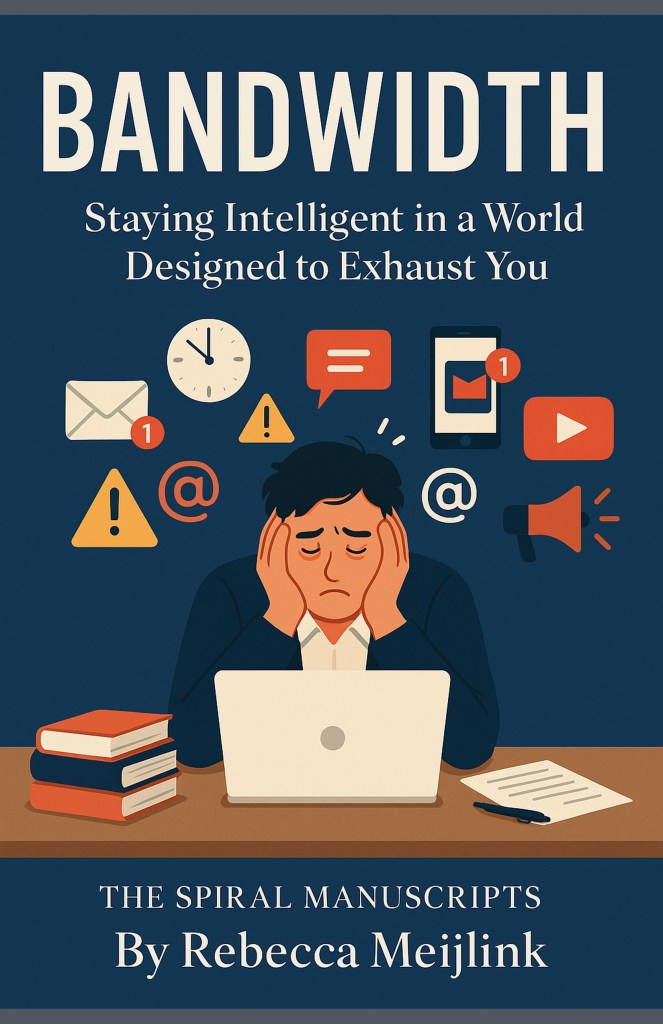
It strips away the myths of productivity culture and exposes the real problem: when the feed becomes the environment, clarity becomes the rarest commodity in the economy. In its place comes constant distraction, emotional volatility, collapsing working memory, and leaders reacting faster while understanding less.
The book gives you the tools to reverse that trajectory. It teaches you how to design your days, your teams, and your systems so that thinking becomes possible again—precise, unfragmented, and load-bearing. In a century defined by noise, coherence is no longer idealism; it is the minimum requirement for survival.
Order your copy on Amazon: https://amzn.eu/d/9sOclb7
Loyalty in the Attention Economy: Commitments That Don’t Eat You Alive

Your loyalty, as a nervous-system override, is someone’s business model. You were praised for being loyal – as a partner, colleague, citizen, believer – but no one trained you to ask the only questions that matter: loyal to what, under what rules, and at whose cost. In an attention economy that feeds on your time, emotion, and identity, unexamined loyalty is the cheapest fuel on the market.
This is a leadership manual in disguise: how not to run teams, movements, or institutions on extracted loyalty; how to design coherent commitments; how to stop needing people slightly broken for the system to function.
Order your copy on Amazon: https://amzn.eu/d/0rIGmQR
Trust In an Age of Rational Distrust
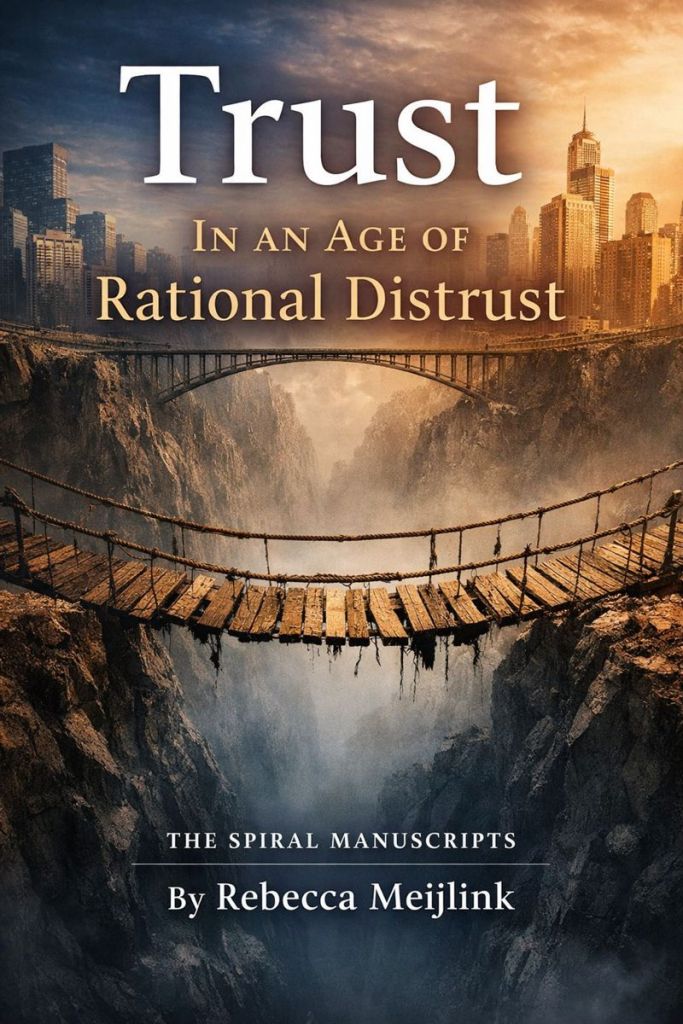
You were told your problem was “trust issues”. You were told you are guarded, negative, damaged, over-analysing. The world around you suggests the opposite: collapsing institutions, performative workplaces, weaponised vulnerability, and people who treat your nervous system as free infrastructure for their lives.
This book starts from a blunt premise: in a low-trust world, your suspicion is not a flaw. It is data. The question is not how to make you more trusting. The question is how to make your distrust more intelligent.
This book shows you how to treat trust as architecture, not virtue. Instead of asking “do I trust them?”, you learn to ask: what can I trust them with, at what scale, under which incentives, and with what exits. You will see why default trust has collapsed, how “trust issues” got turned into a convenient diagnosis, and how to stop paying the price for other people’s patterns with your body, time, money and future.
This is not a book about “learning to open your heart”. It is a manual for people who have seen enough to know that blind trust is expensive and global cynicism is a dead end. You will leave with a sharper map of who has earned what level of access to your life – and the tools to design trust in love, work, and systems on rational terms, not wishful.
Trust will never make you safe. Used properly, it can make you coherent.
Order your copy on Amazon: https://amzn.eu/d/aj9iXCF
The Coherence Economy: How Value, Risk and Capital Behave in a Field-Based World
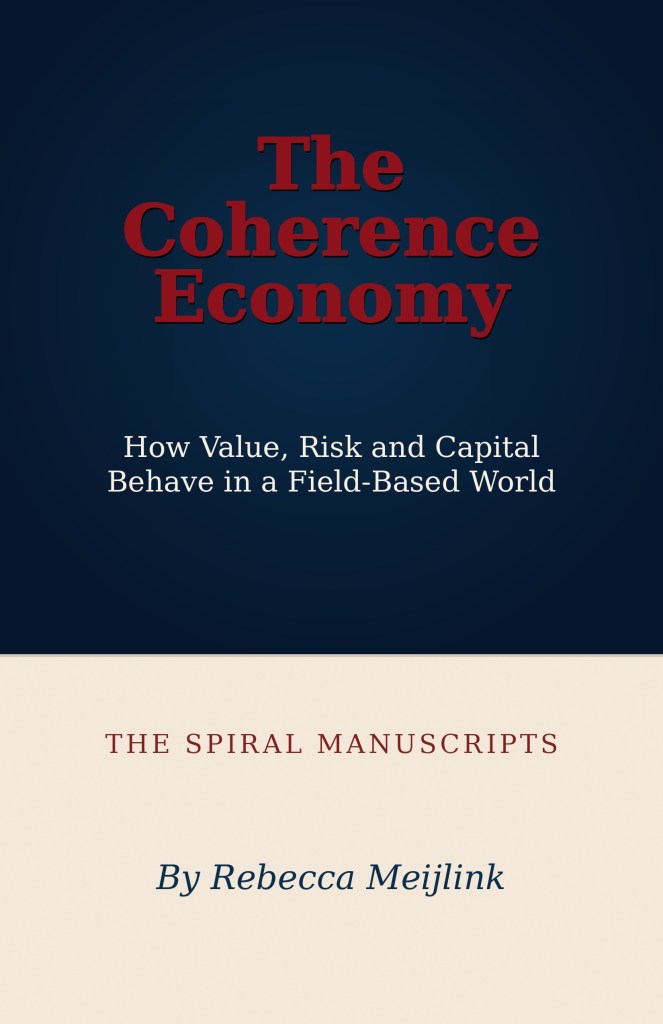
How to Stop Designing Markets That Destroy Their Own Future. Markets did not “go wrong”. They did exactly what we designed them to do: optimise profit inside architectures that quietly burn human bandwidth, institutional integrity and the living world. The Coherence Economy treats that as the core design flaw, not a regrettable side effect. The book argues that an economy is not a neutral machine for moving money. It is the nervous system of a civilisation. Labour policy is nervous-system policy. Housing is a daily threat regulator. Health is regulation infrastructure. Media is collective circuitry. Law, contracts and capital flows decide which architectures expand – and whether a society can still think under load. When those systems are built to ignore coherence, the ability of people and institutions to perceive reality honestly, regulate under stress and correct course, you get precisely what we have: growth statistics on paper and a civilisation losing cognitive function in practice.
Across labour, housing, health, media, law, capital and wealth, this book shows:
- how apparently rational markets are systematically destroying the conditions they need to survive
- why risk models that ignore bandwidth and trust are structurally mispriced
- how “wealth” and “safety” fail on their own terms in an incoherent field
- how cascades, thresholds and coherence debt explain the speed of recent crises
- what it would mean to treat capital mandates, regulation and governance as field-engineering tools, not neutral arbiters
This is a design manual for markets that do not destroy their own future. Written for economists, investors, policymakers, regulators and senior operators, The Coherence Economy offers a blunt upgrade: stop treating coherence as a metaphor and start treating it as the primary constraint. In a century of compounding shocks, the only economies with a future are those that can still think.
Order your copy on Amazon: https://amzn.eu/d/7OqDO3v
The Healthy Nation-State – Nervous Systems, Social Floors, and the Real Resilience of the State
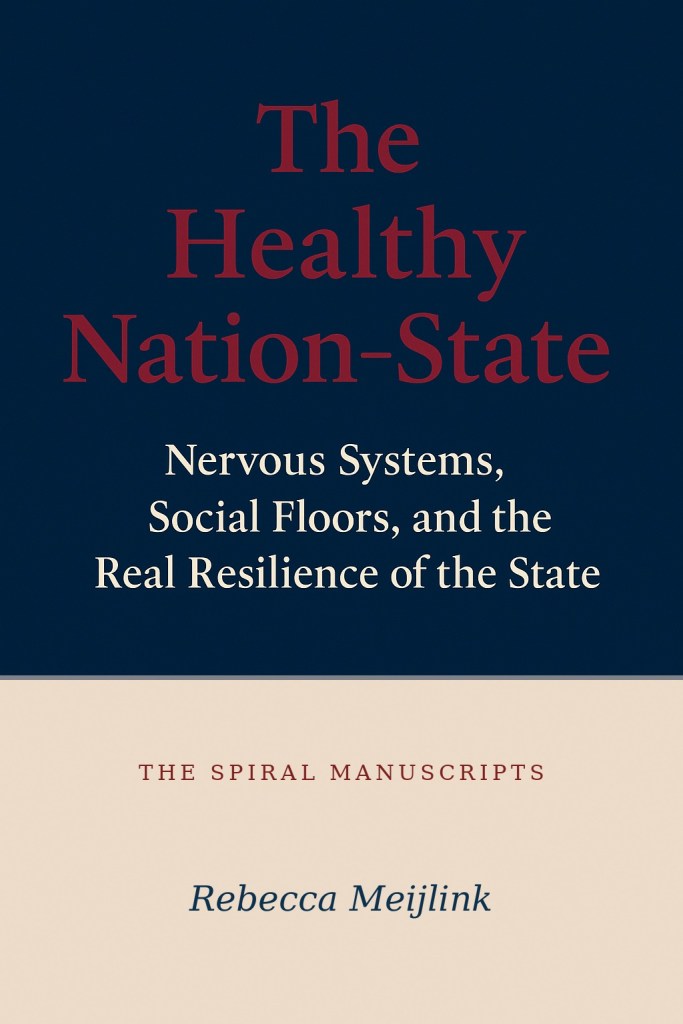
We keep pretending health is a sector. It isn’t. Health is what happens when a nation’s housing, labour market, streets, digital systems, institutions and budgets collide with human nervous systems. Hospitals count the score.
This book treats a country as a nervous-system architecture. It argues that the real resilience of a nation-state lives in two places: the bandwidth of its people and the thickness of its social floor. If those are eroded, no amount of clinical capacity, policing or communications strategy can hold the system together for long.
Drawing on stress physiology, social-determinants research and statecraft, this bookmaps how noise, time poverty, unstable housing, precarious work, hostile bureaucracy and extractive digital design quietly structure illness and crisis. It then shows what a state would look like if it took nervous systems and floors as seriously as it takes GDP and bond yields.
This is a structural proposal: treat health as the operating limit of your civilisation, redesign the architecture accordingly, or watch your institutions run out of human bandwidth to govern with. If you work anywhere near the levers of a state, this is your manual.
Order your copy on Amazon: https://amzn.eu/d/gxDn20w
THE KEEPER LAWS: Timing, Gates, Record, Non-Inversion – Governing High-Power Systems
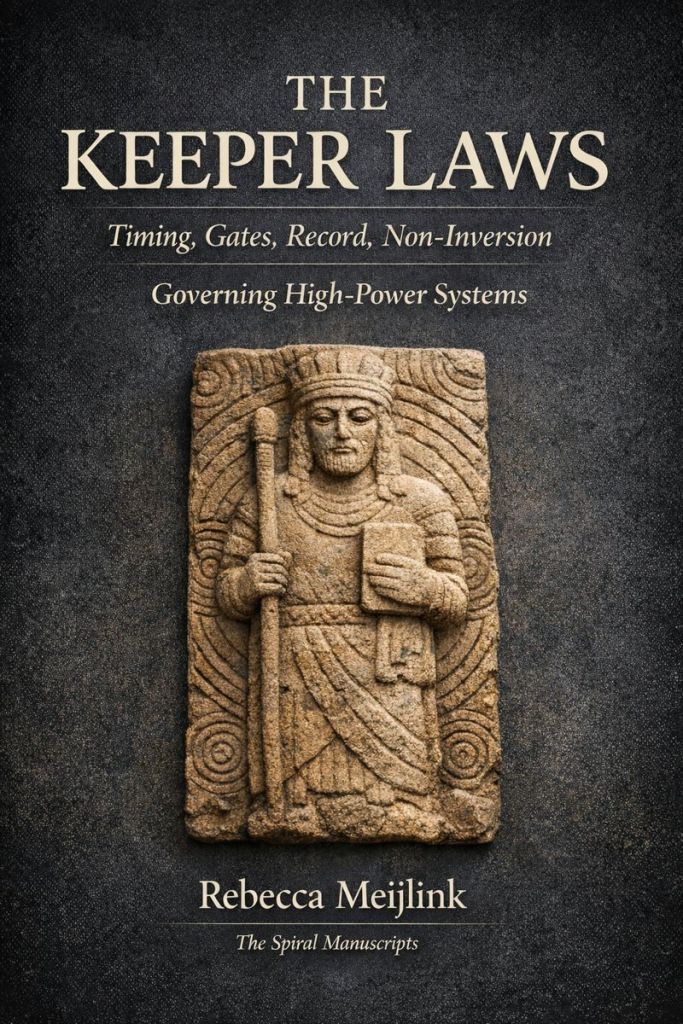
Non-Fiction. A companion work, An’Meya, Keeper of Time Codes: The Past Echoing into the Present, serves as this book’s narrative laboratory. You will find this book under the tab ‘Powered by Pyramids’.
Power doesn’t collapse civilisation by shouting. It collapses it by drifting: one exception, one rebrand, one “temporary” policy, one silent edit, one manufactured urgency until the system’s stated purpose becomes cover for its opposite outcome. The Keeper Laws is a practical framework for building systems that don’t self-invert under pressure. It defines four primitives: timing windows, gates, record integrity, and non-inversion testing. It then turns them into installable constraints: checklists, abort lines, misuse-mode diagnostics, and refusal scripts. This is an engineering approach to governability.
If you build, fund, regulate, audit, or depend on high-leverage systems, this book gives you the vocabulary to see drift early and the mechanisms to stop it.
Order your copy on Amazon: https://amzn.eu/d/f08Ws7R
Gates Not Doors: Conditions Against Corruption
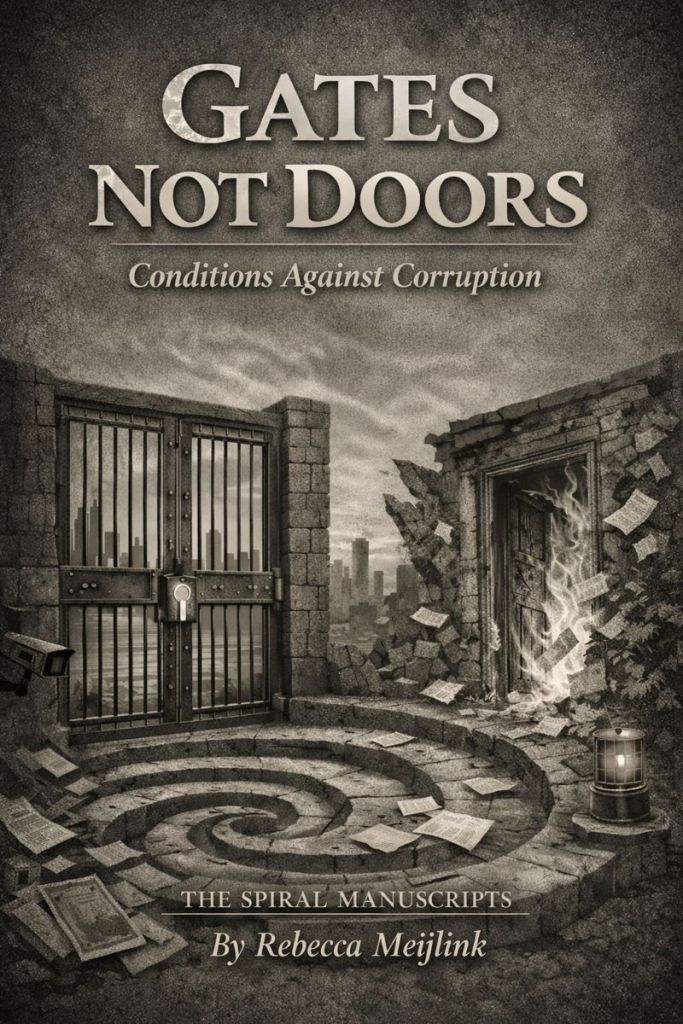
This is a systems book about the most under-designed problem in modern life: who gets access to leverage.
Most organisations still run on doors—discretionary permission, social pressure, backchannels, and expanding exceptions. Doors do not scale. Under load, they become a capture interface.
This book replaces doors with gates: explicit purpose, explicit variables, explicit opening conditions, explicit refusal logic, minimal monitoring signals, and emergency seals that do not become permanent emergency.
It is written for founders, executives, product and security teams, grant-makers, investors, and public institutions—anyone allocating leverage and trying not to build a control regime by accident. This is not “ethics”. It is engineering for non-capturable systems.
Order your copy on Amazon: https://amzn.eu/d/in44fQ0
The True Work of Money: How to Rewire Emotional Loops into Coherent Capital
Money is not love, status, safety, or validation. It is a coordination instrument. Yet people, companies, and governments use it as a substitute nervous system, trying to regulate fear, shame, envy, and belonging with numbers in an account. The result is predictable: revolving debt, compulsive consumption, hoarding that never feels safe, corporate theatre, sovereign borrowing spirals, and a planetary economy treating the biosphere as a limitless credit line.
This book names that mistake and rebuilds the architecture from the ground up. It starts at the individual level, and then scales to organisations, nations, and the planetary system, so you can read any balance sheet or budget as a loop map – and use money as a clean tool for repair, resilience, and coherent capital.
Order your copy on Amazon: https://amzn.eu/d/7XEaTDO
Search ‘Rebecca Meijlink’ on Amazon — all publications are available there.
Important Notice: By continuing to browse this site, you confirm that you are over 18 and have read and accepted the Legal Notice & Disclaimer: https://spiralmanuscripts.com/legal-notice-disclaimer-terms-of-engagement/.
#leadershipdevelopment #leadership #ceo
 The Spiral Manuscripts