
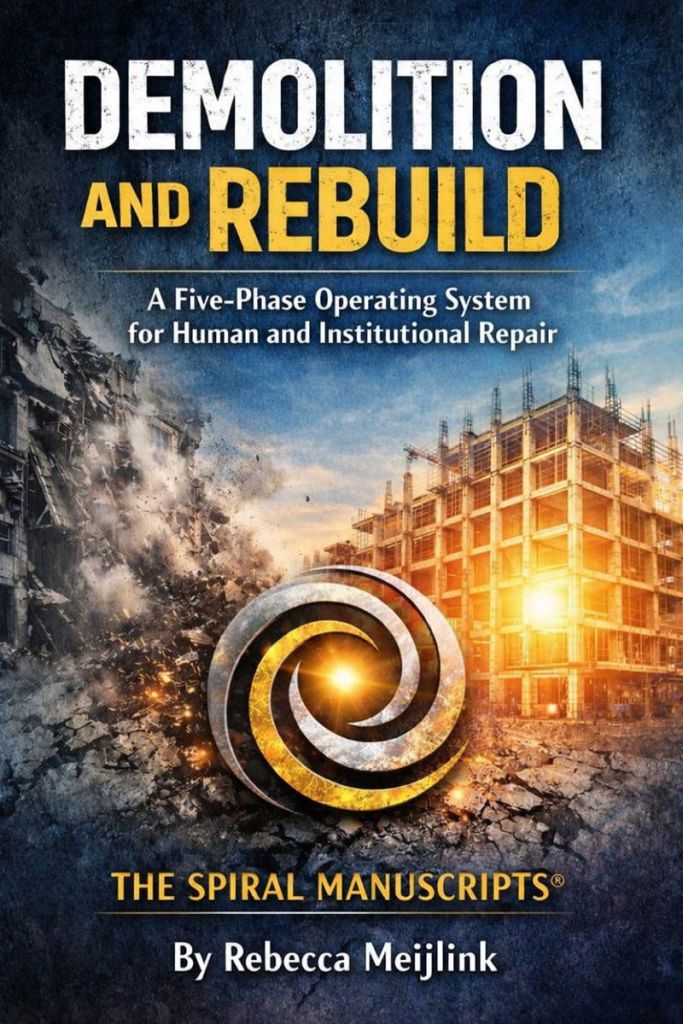
Extract from Demolition and Rebuild: A Five-Phase Operating System for Human and Institutional Repair
These operating rules define a repair sequence for systems under stress, applied at individual scale. They are execution constraints designed to prevent rebuild theatre, recurrent collapse, and structural inversion.
Core operating rules (individual implementation)
- Demolition is structural, not performative. If something repeatedly degrades your baseline, treat it as non-viable.
- Most collapses are sequencing failures. Skipping Orientation and avoiding Refusal guarantees fake repair.
- Orientation is forensic reality contact. If you cannot map the dominant loop, you are not ready to act.
- Refusal is termination with evidence. Not a mood: a decision expressed in artefacts and boundary enforcement.
- Reset is controlled input reduction. Same inputs = same collapse.
- Repair is modular or it is theatre. One change at a time, tracked to outcomes.
- Rebuild is architecture, not “growth”. Include recursion, audits, error logging, and exit criteria.
- If it cannot be evidenced, it did not occur. Insight and intention don’t count; outputs do.
- Drift is inevitable. The metric is detection speed and correction speed.
- Inversion is the stop signal. If an intervention worsens stability: stop, log, roll back, return to Orientation.
- Baseline stability is a strategic asset. Without it, decisions distort and relationships become reactive.
- Exit is capability, not failure. Clean exit and clean re-entry are maturity markers.
Demolition and Rebuild: A Five-Phase Operating System for Human and Institutional Repair: Key message
Most systems do not fail because they lack intelligence, effort, or intention.
They fail because they refuse to demolish what no longer functions.
This book is a structural operating manual for situations in which repair has failed, drift has become permanent, and performance has replaced execution. Written for operators rather than optimists, Demolition and Rebuild provides a non-narrative framework for terminating failed architectures and rebuilding systems that can survive volatility.
The Five-Phase Operating System — Orientation, Refusal, Reset, Repair, Rebuild — is an execution sequence designed for use when identities, habits, institutions, or nervous systems have reached terminal instability. Each phase is protocolised, artefact-driven, and auditable. Sentiment, motivation, and legacy are treated as risk factors rather than inputs.
This is not a book for comfort, reassurance, or personal meaning. It is for those prepared to terminate what is failing, tolerate uncertainty, and rebuild without sentimentality. In return, it offers something rarer than optimism: a system that actually works.
The field does not reward intention.
It rewards structure.
Note: This is not medical or therapeutic advice; it is an operational framework for decision, sequencing, and execution under stress.
Routing: About The Spiral Manuscripts – Institutional Implementation – Individual Implementation – The Five Phase Method – The Operator Interface Architecture – Domain Architectures – Future Business Architecture – Spiral Operator Institute – Narrative Interfaces (Symbolic Transmission) – Library Orientation & Index – Operator Resources – Frequently Asked Questions –Publication Notices – Governance & Legal
 The Spiral Manuscripts