
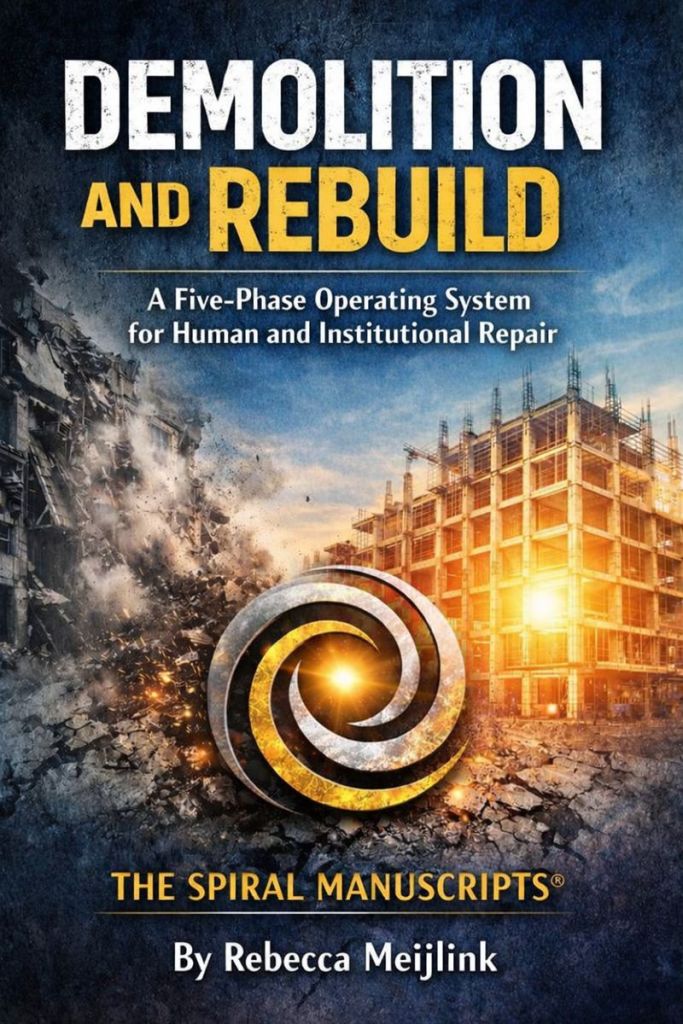
Extract from the book Demolition and Rebuild: A Five-Phase Operating System for Human and Institutional Repair
The following operating rules are drawn from Demolition and Rebuild: A Five-Phase Operating System for Human and Institutional Repair.
The book defines a repair sequence for systems under stress, applied at both individual and institutional scale. These principles are not values or recommendations. They are execution constraints designed to prevent rebuild theatre, recurrent collapse, and structural inversion during transformation efforts.
- Demolition is not emotional. It is structural.
If something repeatedly degrades your baseline, it is not “challenging”. It is non-viable. Treat it as such. - Most collapses are sequencing failures.
Systems break because they skip Orientation, avoid Refusal, and try to Repair on an unstable baseline. You cannot repair what you refuse to stop. - Orientation is not contemplation. It is forensic reality contact.
If you cannot map the dominant loop, you are not ready to act. - Refusal is not aggression. It is termination.
It ends what cannot be made coherent. It is not a mood. It is a decision evidenced by artefacts. - Reset is not rest. It is controlled input reduction.
If you keep the same inputs, you will keep the same collapse. - Repair is modular or it is theatre.
One change at a time, tracked to outcomes. Anything else is performance disguised as progress. - Rebuild is architecture, not “growth”.
A rebuilt system must include recursion, audits, error boxes, and exit criteria, or it becomes the next cage with a new name. - If it cannot be evidenced, it did not occur.
Insight does not count. Intention does not count. Explanation does not count. Artefacts are the only proof of execution. - Drift is inevitable.
Not a character flaw, but what happens when systems stop being challenged. The issue is detection speed and correction speed. - Inversion is the primary danger signal.
When an intervention worsens stability: stop, log it, roll back, and return to Orientation. Good intent does not prevent inverted outcomes. - Refusal without containment produces chaos.
Premature demolition destabilises systems lacking baseline, mandate, or safety measures. Use the triage gate. - Baseline stability is a strategic asset.
Without it, decisions distort, relationships become reactive, and projects become theatre. - Exit is not failure. Re-entry is not regression.
Both are standing capabilities of a resilient operating system. If you cannot exit cleanly, you are trapped. - Operator error boxes are immunity infrastructure.
A system that does not log error will repeat it. A system that hides error will rot. - Field clinics prevent ossification.
Any protocol that cannot be stress-tested is already becoming a myth. - Peer and external validation are mandatory at scale.
Closed-loop systems self-deceive. Audit is the antidote. - Comfort is not a metric. Morale is not a KPI.
Valid standards are: reduced error recurrence, increased bandwidth, stable baseline, clean outputs, and recoverable execution under stress. - The rebuild must survive you.
If it only works when you feel calm or motivated, it is not a system. It is dependence on mood. - You are not obligated to preserve old identity.
The operating system does not care who you were. It cares what you can run now. - This is not a one-time sequence. It is a living OS.
Orientation and Refusal are permanent functions. Mature operators return to them early, before collapse forces the return.
These are the rules that keep the manual clean.
Break them, and you will rebuild the same life in a new outfit.
Run them, and you will create something rarer: a system that holds.
Demolition and Rebuild: A Five-Phase Operating System for Human and Institutional Repair: Backcover
Most systems do not fail because they lack intelligence, effort, or intention.
They fail because they refuse to demolish what no longer functions.
This book is a structural operating manual for situations in which repair has failed, drift has become permanent, and performance has replaced execution. Written for operators rather than optimists, Demolition and Rebuild provides a non-narrative framework for terminating failed architectures and rebuilding systems that can survive volatility.
The Five-Phase Operating System — Orientation, Refusal, Reset, Repair, Rebuild — is an execution sequence designed for use when identities, habits, institutions, or nervous systems have reached terminal instability. Each phase is protocolised, artefact-driven, and auditable. Sentiment, motivation, and legacy are treated as risk factors rather than inputs.
This is not a book for comfort, reassurance, or personal meaning. It is for those prepared to terminate what is failing, tolerate uncertainty, and rebuild without sentimentality. In return, it offers something rarer than optimism: a system that actually works.
The field does not reward intention.
It rewards structure.
Routing: About The Spiral Manuscripts – Institutional Implementation – Individual Implementation – The Five Phase Method – The Operator Interface Architecture – Domain Architectures – Future Business Architecture – Spiral Operator Institute – Narrative Interfaces (Symbolic Transmission) – Library Orientation & Index – Operator Resources – Frequently Asked Questions –Publication Notices – Governance & Legal
 The Spiral Manuscripts